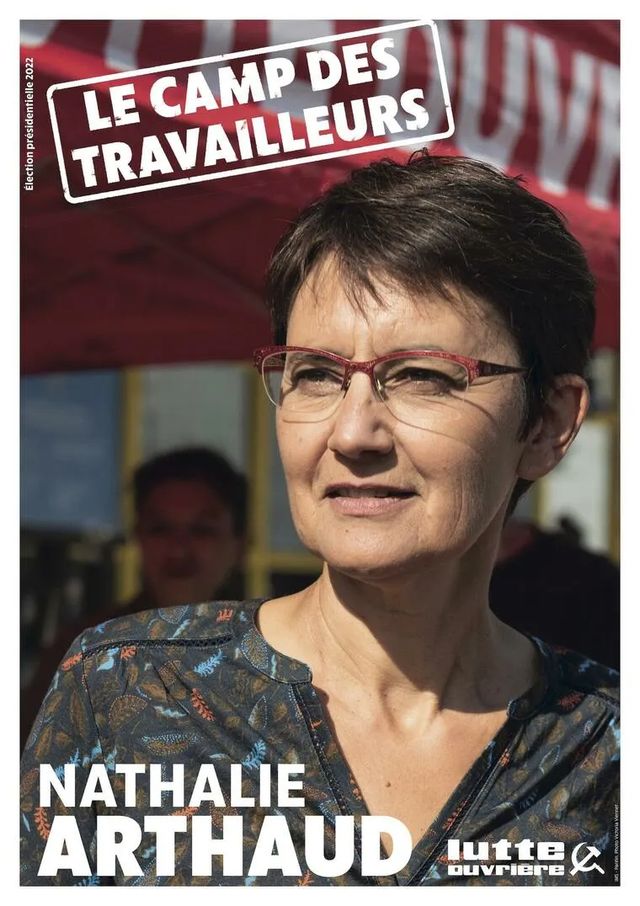
Next up is this poster–not particularly striking at first, but I find the reactions to it interesting from a gender studies perspective.
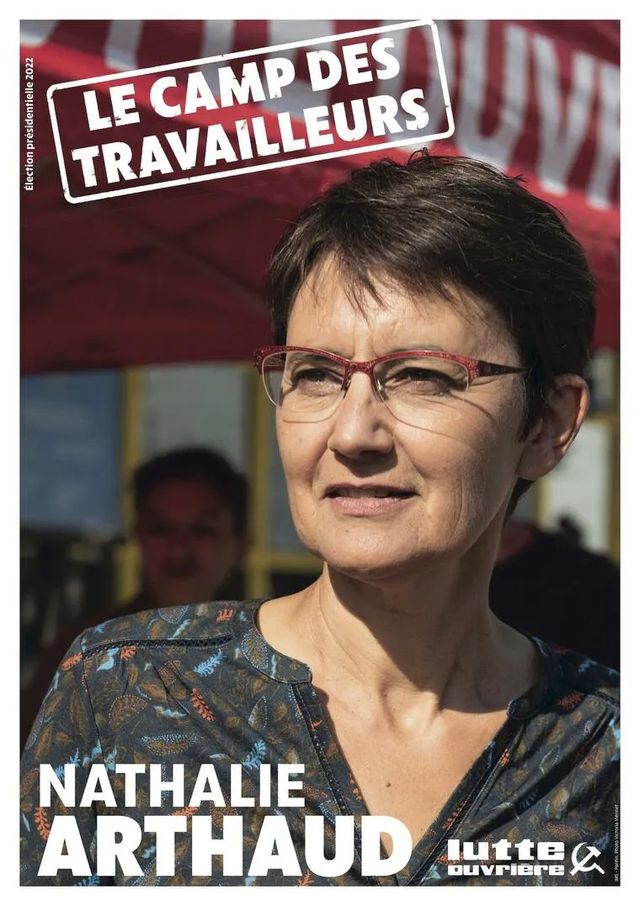
Okay, so this one is an easy one: the hammer and the sickle on the bottom right corner give it away very easily: it’s a far left party. France has no less than 4 or 5 far left parties/candidates running this year, although one is staunchly refused the far left label, but we will come back to this.
The flyer I got differed a tiny bit from this one–it was clearer that the candidate was amongst an union demonstration, probably the ones that happen every year in France for Labor Day.
As an aside, Labor Day in France is on May 1st, not in September. The date is also a labor movement celebration, but it is not arbitrarily chosen, it originally commemorates the troops shooting at a pacific labor demonstration on May 1st, 1891, in the town of Fourmies, in the North of France. France had legalized the right to striking and unions prior to the movement, in the mid-1880s, which is why the events in Fourmies were so shocking to the country. The military killed 9 workers, mill workers mostly, and the memory of that event sustained the labor movement for the rest of the century and part of the next. May 1st is often cited as a holiday Marshal Pétain (the head of the repressive Vichy government) installed, but that is not actually true–Georges Clémenceau (whom I mention in post 1 to explain the inverted color spectrum in France versus the US) had his Senate vote it in 1919. If you’ve read my first post on the campaign flyers, you know this chamber was conservative, so it might come as a surprise that they legalized the work day of 8 hours, and made May1st a holiday in the same movement. In fact it shouldn’t be–it was to counter the rising influence of the Communist Party, and the French International Workers Federation (the SFIO, which had yet to split between communists and socialists at the time). Clémenceau made the quick calculation that if he made this concession, he could dominate the political field, and he was right.
During WWII, Pétain dubbed the day “Labor and Social Concord Day,” which is actually an apt descriptor of what Clémenceau intended: give away a little to buy social peace. After the war, because oft he misrepresentation that Pétain had invented May 1st, and with the progressive disappearance of the Fourmies events from collective memory, there was a brief moment to change the date because of its tenuous affiliation with Pétain. Fortunately, French historians were prompt to remind armchair historians (which is, as one of my college history professors reminded us every year, every French, because history is a discipline for which laypeople have a a deep-seated interest in France) that May 1st was not a Pétain invention.
May 1st is also the day that Le Pen Sr chose in 1988 for his Joan of Arc celebration–I’ll pass here the details of why the far-right celebrates Joan in France, but that is not a new phenomenon–she was coopted by nationalists when she reappeared in French-lore at the end of the 18th century, but particularly in the 19th century. Every year since then, May 1st is often a day of high alert for Parisian police, and regularly makes the news for the theatrical stage it’s become, with regular fights between far-left and right parties.
The background of my flyer shows very distinctively the banners of Lutte Ouvrière (Workers’ Fight) behind the candidate, and it shows also more clearly than the campaign poster that Nathalie Arthaud is walking and looking towards the left, ahead of the audience’s shoulder. She is wearing a very simple outfit, which our comm consultant (see part 1) calls “a schoolmarm outfit” (she uses professor in the French version, but what she means is a derogatory way of describing an old-fashioned professor, with all that implies in France: a left-wing, provincial person, with limited ideas, either totally against discipline or too much of a disciplinarian, in short someone who cannot do–so they became a teacher).
The consultant from post 1 isn’t the only one to have described Arthaud this way, and her historical predecessor, beloved favorite of political caricature, Arlette Laguiller, made a profession out of dressing like this, and similarly got denied for it.
Not too put too fine a point on it (okay fine, totally putting too fine a point of it), but the gender discrepancy is absolutely astounding: two of the other far-left candidates dress in similarly dressed down ways, or in ways that remind the audience of a school teacher. One also has glasses that are similar and wears also a forced smile like Arthaud does.
Bizarrely, no one has commented on their outfit saying they looked “banal, “schoolmarm-like”, or any of the other pejorative terms that have been attributed to Laguiller, and now Arthaud. If y9ou speak French, it’s worth Googling Les Guignols de l’Info and Arlette Laguiller to see how bad it was.
This poster is nowhere near as bad as many commentators have made it out to be: it shows a humble candidate, without overplaying the blue-collar thing like another far-left candidate does, it shows the power of unions, and it has no pretension of being anything else than what it is. Of all the posters, this might the most pared down and honest, despite its greater composition.
But! I cannot also not apply the same criticism of classist issues that I made in post#1: blue-collar does not have to have to mean dressed down, and I feel conflicted on this one. On the one hand, Arthaud is not pretending to be dressed down, as Philippe Poutou, another far-left candidate is. She is actually quite tastefully dressed, not too flashy, not too modest. On the other hand, it would be refreshing to see a female far-left candidate wear a suit once in a while, just like the male Communist candidates have been doing for a while now, although I understand why Arthaud is refusing this thatcherian model of politics.
In any events, the effect she’s going for is working here, and it’s also interesting that she’s one of the few candidates who hasn’t chosen a solid color background this year.
 The Traveling Scholar | AC Sieffert, PhD
Leave a comment