As a teacher, and a scholar trained in Gender Studies, I am very aware of how gender influences what we do and how we perceive others in the classroom. There are many aspects to this issue: the gender gap in higher education for students, gender in K-12 teaching, as well as gender inequality within the professional and social world. All are issues that interest me, but I have particular experience and background in dealing with K-12 gender issues, and college-mentoring for students around the intersecting aspects of gender, race, and citizenship.

Between the spring of 2009 and the spring of 2010, I participated in three pioneering programs in Strasbourg.
These three events were organized through the commission for education accessibility and gender equality, created in 2005, and tasked with helping bridge the gap between boys and girls in education and society–a problem with deep-seated causes in French society.
In France, only 28% of engineering degrees in 2013 were delivered to women, in contrast with 74% of literary degrees granted to women. The United States is confronted with the same gender gap in higher education and careers.
Similarly, at the end of high school, only 30% of women chose scientific concentrations. Additionally, like in the United States, newer generations of boys in K-12 tend to underperform, while long and short-term issues of representations and salary-range differences still persists, favoring men over women.
On March 16, 2009, the school district authority, through its Commission for Equality in Educational Access’s liaison, invited me to a three-members panel discussion with K-12 faculty members from all over the district.
My talk centered around introducing what gender meant and how it is built to the faculty members present. As part of the panel, I did a quick workshop with the faculty members to highlight stereotypes in gender construction. Teachers got handed a grid in which one column stated different item categories such as color, car, work, hobby, etc. The two next columns said Man, Woman. The audience was asked, after being reassured that there were no bad or good answers, to fill out the rows with one word for each category, and each gender. Without looking at the tallied up sheets, I then predicted for each category the outcome, and had a member of the audience tally the categories. They each corresponded to most of my predictions. Of course, the idea of this test is not a controlled cognitive one, but to show that, when talking about gender, most people expressed the exact same answer, because intuitively, they already knew the social construction aspect of gender and knew what answer I expected of them. Going from there, though, it was not hard to have them walk backward to the point where they admitted they had said this because society, their family, or some other external factor expected this particular item for this particular gender to correspond to this particular answer.
From there, I transitioned into the work done by scientists to show what real sexual differences and what was just part of. societal construction–in particular, the good old “boys are better at maths”, which is actually no longer true in 2017, since in most Western countries and Southeast Asia, young girls over perform in science classes, over their male counterparts. A study by Penn State in 2005 showed that GPA differences in maths between girls and boys were negligible, and much less important than they were in the 1980s–and accounted for these differences by examining the way both sexes were taught, and finding significant social, and not genetic, differences. As reported by this The Atlantic article, by 2014 the slight statistical difference had not only disappeared, but girls were outperforming their males counterparts in almost all of the 369 studies analyzed in Drs Daniel and Susan Voyers’ meta-study (the study found that, in the 21st century classroom, those who succeeded were kids who tended to be better at self-regulating, a behavioral tarit instilled early on in young girls, but less so in boys). We then talked a bit about the history of gender theory, and the idea of spectrum, based on my Safe Space training. The interesting part about it is that when gender theory is introduced like this, there is not a single negative reaction, whereas a Ministry of Education poll showed teachers were not necessarily receptive to the idea of gender when the Charter for Gender Equality was implemented. If anything, the only question that came up was “what do we do with this information now?”, so we finished the day with practical ideas about self-awareness in teaching–implementing strategies such as counting the times one calls on girls or boys in class, making sure that visual material is representative, being proactive in having outside actors intervene, etc.
The same year, on June 5 2009, I participated in a smaller scale programming meant to help district faculty negotiate gender in the classroom. This daylong workshop was held in the high school Marc Bloch in Bischeim, France, and was a part of a series held throughout the year and coordinated by Virginie Jeltsch, the liaison.
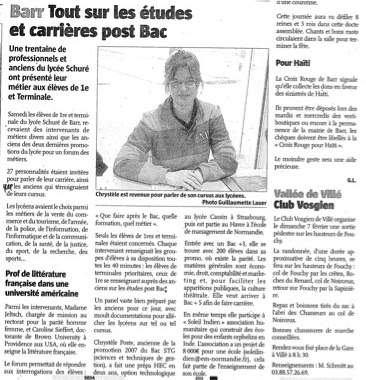
The following year, in 2010, a public vocational high school (Lycée Schuré of Barr, France) invited me to talk at a career fair, after one of their faculty members heard my talk in 2009. There I met high schoolers to whom I explained what a career in higher education entailed and what gender studies research consists of.
All of these were extremely fruitful cooperations.
Students feedback during the career fair included the belief, for females, that “they couldn’t possibly be engineers, it didn’t make sense–besides, I’m not good at maths, like all girls”. Mainly, feedback revealed how far we still have to go as a society. Students were enthusiastic and events got good press coverage in local newspapers, but they contributed to show how deep-seated the gender gap is in K-12 education.
Participating in these events has offered me the chance to use my scholarship to bridge the gap between research and the world–it has made me a better mentor and teacher to my college students.
After this collaboration, I have been working further to refine inclusive material to make students more aware of the gender inclusion issues.
I have for example developed classes trying to bring theory to students, and make it more accessible to them through experiences in their real world. For example, I taught a class on minorities in France from the 18th to the mid-1960s, and inserted some gender theory–to make it more accessible, we worked with students on how to articulate their daily life in terms of gender representations.
It is not, by any means, an easy workshop to administer–it relies a lot on discomfort, and the ability of the teacher to make students feel safe enough to not close up to these ideas–but it works extremely well in making students aware of mechanisms they might not even think of. In diversity, inclusion, and equity, increasingly, there is work done on implicit bias. Most people by now have heard of the controversial Project Implicit, a test imagined and maintained by Harvard University scholars. The Implicit Association Test relies on gauging one’s implicit biases–it is somewhat controversial as it was sold by the press as a one-time test that could tell the user whether they were implicitly prejudiced or not (in reality, the research team was always clear that the best results are achieved by doing the mean of several rounds of IAT testing), and it is influenced by the user’s desire to “look good” (no one likes to admit they are racist!). This is the same reason for which implicit bias as a concept is problematic by some aspects: the test fails because it relies on users to be truthful in all situations, even in ways in which the user is perfectly aware of a bias, which therefore cannot be an implicit bias.
Arguably, it is very hard to measure implicit bias, and it has political implications (it skews polling on a variety of issues, like polls trying to assess the interest in neo-fascist groups), but nevertheless, the above exercise (which to some extent derives from the same research behind the IAT) has the merit of showing students how some associations can be subconscious (types of cars by gender is one of the most interesting items here).
Coupled with other exercises, it offers a good starting point, especially when offered alongside research on gender bias and its implications in the job market, the relationship to space, sexuality, and so on.
This is work that I have done in many contexts and classes over the last 5 years in a teaching space in US higher education, and I continue to be in contact with the Mission for Gender Equity in Strasbourg, working on the next generation of programs for access equity in education.

This work is licensed under a Creative Commons Attribution-NonCommercial-ShareAlike 4.0 International License.
 The Traveling Scholar | AC Sieffert, PhD
Leave a comment