As a part of the Brown University Scholars Training (BEST) program, I worked on mentoring practices at Brown University, and tried to identify good practices in and outside of the university.
One of the reasons why so many graduate students enjoy Brown is its diverse graduate student and close community. This diversity also means there isn’t one cookie-cutter solution to everyone’s difficulties and challenges with graduate school, and the atypical aspects of a small-scale graduate school promote at the same time a more personalized approach, but also bring up some issues associated with the contrast between the nature of graduate studies, and the comfort of a small community.
My plan, on working on this subject, as to identify issues, and possible small and large scale solutions that existed within Brown and could be extended to the whole school, or outside of Brown and could be adapted there.
Brown’s Graduate School by the numbers, when I started off this project:
One out of three student is a Master student—and 43% of these are not supported financially by the Graduate School. PhD students on the other hand have financial aid at a rate of 70%. Financial stress has historically been cited as one of the highest factors preventing timely graduation–in fact as early as 1967, Brown’s administration was concerned about it.
With a contingent making up to 30% of the student body, international students are a conspicuous presence on campus. In 2013, there were 1986 grads on campus, and 687 of them were non-resident aliens. International students come from 69 countries across the globe.
First generation students, students who are the first in their families to go to college/graduate school, are not statistically documented at Brown, in the Graduate School, but they represent a small percentage of PhD and Master students. According to a University of Arizona study (http://www.u.arizona.edu/~jag/POL602/firstGen-profKniffin.pdf), only 24.6% of first generations students go onto graduate school after college, as opposed to 34.2% of students who had at least one parent go to college–but it is even worse if one looks at the doctoral level. Whereas 4% of students who have had at least one parent go to college go to graduate school for a doctoral degree, only 1% of first gens ever make it to PhD programs.
The average age of graduate students in the US is 32 years old, and the average PhD age at Brown is 27 years. Although Brown does not keep track of families, it once did, and in the late 1960s, 40% of graduate students had children–a number likely higher than today for structural reasons.
Minority students: although international students tend to skip the ethnicity question, in 2010, 294 US nationals (accepted and incoming students) identified as minority students in their application to Brown. Today Brown has an average of 43% of students in the Class 2017 identifying as students of color, a different reality than during the 1968 Walk Out.
As the number of BA degree-holders in the United States has raised in the past twenty years, so has the number of MA students. The average age of Master students is 25 years old at Brown.
Finally, at Brown, there is about a 50% distribution of the gender divide.
At Brown, like elsewhere in the United States, as graduate schools grow and diversify, higher education institutions still fail to find solutions to the lack of visibility the graduate student community suffer from and the wellness problems that affect graduate students.
Not only do academic demands multiply once you’re in graduate school, but former outstanding undergraduate students are now a part of a cohort of other equally outstanding students…This can lead to adjustment difficulties and feeling like you are an imposter or unsuited for the rigors of graduate study. (Williams-Nickelson The Benefits of Peer Mentoring 1)
Credits: Psychology Department CUNY
Graduate School is frequently isolating and alienating as an experience, and even more so for international students, who are fast growing amongst the ranks of our students.
Approximately 50% of international graduate students, according to a 2008 Berkeley study, have mental health issues, but yet, at Brown, they constituted a marginal percentage (estimated to 10%) of students consulting with Counseling Services.
In my time at Brown, I have worked at alerting the administration to these underlying problems. They are not new in academia: in fact, they always existed. Shockingly, however, and despite a general agreement that better mental health and peer mentoring practices lead to lower attrition rates, we still consider stress and crisis as the normal attributes of graduate school.
At many institutions I have taught or been trained at, for example, only a handful of departments practiced active peer mentoring and had clear, written rules for mentoring by professors, despite the recognized benefits of both, as is explained by the University of Washington’s Graduate School.
Geology, History and French Studies, at Brown University, amongst others, had mentoring systems of their own. As a good practice example, outside of the university, I also reached out, during the course of the study, to Dean Nancy Pope, an alumna of Brown (Associate Dean of the Graduate School of Arts and Sciences at Washington University in St-Louis) to speak about their support system for graduate students.
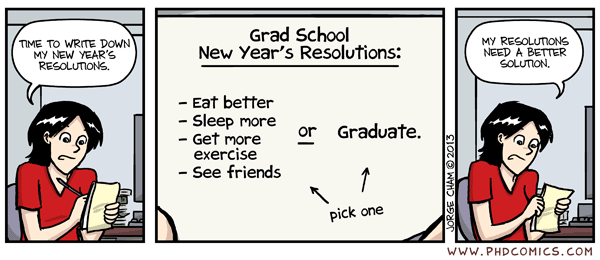
Piled Higher and Deeper, a Comic: one of the many ways our community envisions and accepts mental health and stress as integral parts of Graduate School
At Brown, the Graduate School is currently actively working on more prophylactic ways to deal with students, so that the administration can have clear guidelines for mentoring, better protection for graduate students, and so that we finally start considering students before they land in Counseling Services.
In regard to this, my work in the summer of 2014 with the International Orientation for Graduate Students was in the continuity of my advocacy with Brown University for better mentoring practices.
The conclusions of my report to the Graduate School the summer of 2014, after International Orientation for Graduate Students, were the following:
What this campus really needs in the longer term, however, is a way to connect graduate students to the resources we offer them. (…) I recognize that undergraduate students are the primary target for education on this campus, but graduate students need to know they are given the same holistic consideration their students are granted.
Moreover, the fact that most Graduate Student Peers during this year’s Orientation reported wanting to keep in touch with their group, and enjoyed helping their groups through Orientation is encouraging, and I think, given the proper incentive (in the form of a certificated program for graduate student mentors, like MIT does, for example), graduate student peer support at Orientation could grow into an university-wide peer-mentoring network. Small table-setting is a great step forward, and we should keep it, even if splitting Masters and PhDs might eventually be required, because Master students’ needs are vastly different from PhDs’ and their median age is lower than PhDs’. Masters now constitute the bigger demographic of our entering class (…).
Graduate Student Peers perceived giving their emails to their table as a fun, community-building action, and not as a burden, and most remarked that they might set up programs similar to this in their own departments to welcome new students. I believe that, unlike undergraduate students who benefit from the centralization of these support systems through Meiklejohn, peer mentoring in the graduate student community should be community and department-based.
And yet, I strongly believe that the only way these sorts of programs will exist in individual departments is either if Brown pools resources to make certificated training available to graduate students; or if the Graduate School (and Brown) offers both intellectual and financial support to this, in the form of a clear explanation of what is peer mentoring and what it should and should not entail, and small allotments of money for meetings with mentees twice a year (coffee and cookies type of events).
In other words, I am convinced that Orientation’s format this year is a necessary step, but should only be the first one, and that our longer-term goals should be:
On campus programming support specifically for graduate students (…),
Developing support for department-based peer mentoring programs (…). This support would include a handbook, financial support, workshops to help train mentors, and access to counseling deans for anonymous reporting in case of perceived emergencies.
(…) There is no question in my mind that, given the amount of time and the investment departments make in graduate students when they choose amongst a competitive pool, they should be helped to take better care of graduate students, because they are the primary players in this, and they have vested-interests in lesser attrition rates. There is also no doubt to me that the Brown’s administration should make an effort to understand areas in which we still fail to provide programming to develop a sense of belonging for graduate students.
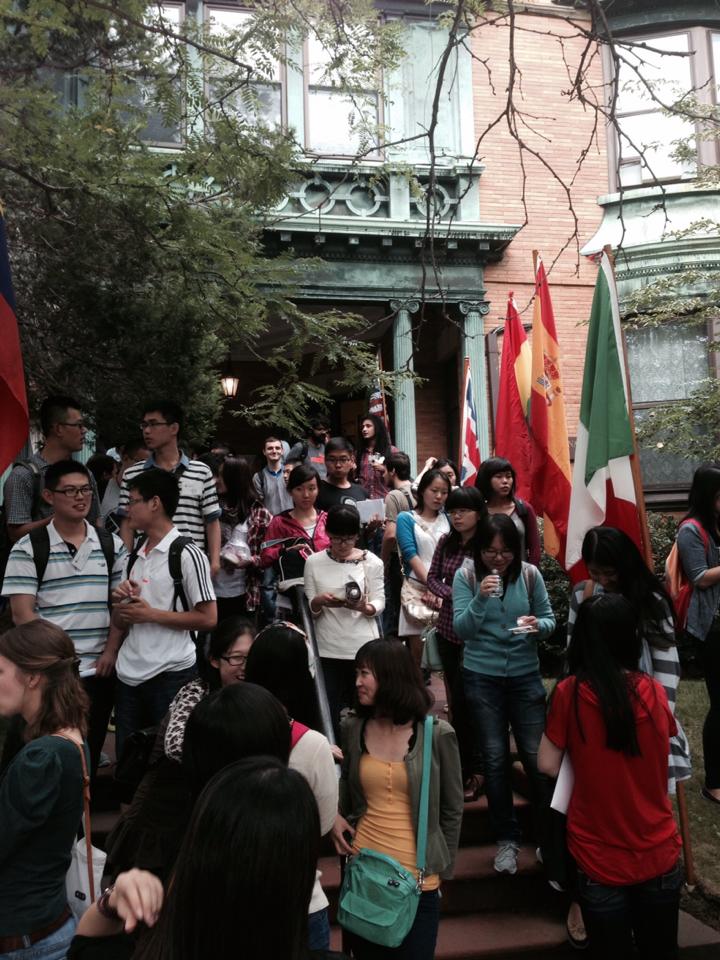
International Students at the International House of Rhode Island, August 2014
Since this report, these are the programs now offered on Brown’s campus to address the systemic issues the graduate students community was faced with in terms of wellness and student life highlighted in my report:
In 2015, the Graduate School inaugurated, in conjunction with the Office of the Vice President for Diversity, a grant for Graduate Students groups;
The Graduate School, the College, SEARS (disability services), the Women’s Center, the Center for Students of Color, the Title IX office, and others on campus, now offer year-long internships that can replace a year of funding, and these were expressly created with the idea of bridging research and community;
In 2016, the Office of the Ombudsperson announced a competitive training program involving a grant to pay for a certified mediator training program (much in the form of the one at MIT described above in my comments);
For the first time, in 2016, both commencement and orientation were fully split between Masters and PhDs, recognizing that the numerical division made it impossible to have singular events.
Some steps were also taken before the report was issued, while I was an officer of the Graduate Student Council: as part of the agenda of the executive board I was on, the GSC president and I co-authored a motion asking Brown to extend privileged-access to the Ombudsperson to graduate students–since then that office has been made permanent and full time, as well as opened to graduate students. We also instituted in the summer of 2012, mid-way through my first term as the Vice President for Social Events and Student Life at the GSC, peer groups at general orientation, instead of the traditional executive board presentation the GSC used to have.

 The Traveling Scholar | AC Sieffert, PhD
Leave a comment