Okay, let’s get this guy out of the way before we get into some of the major disasters of disastrous campaigns and minor candidates. I mean, at this point thes has become fairly arbitrary-but bow we are coming to the uninspiring lot, or flyers for people I have a hard time taking seriously, when they don’t have any parliamentary representation or come out of the woods once every five years, or are polling so far behind no one knows why they are still in there.
This guy is not entirely badly represented here, I just have nothing more to say on him than I did on Nathalie Arthaud, and at least she looked serious.
RED. RED EVERYWHERE. Okay, it’s not necessarily bad, but that is a LOT of red. The NPA (New Anticapitalist Party) was founded in 2007 as an offshoot of a far-left party, the Communist Revolutionary League. So hence the red.
I actually happen to like the guy who founded the NPA, Olivier Besancenot. He has a BA in history, and regardless of whether you agree with his positions, the guy is smart and has said plenty of intelligent things. Besancenot, for example, once remarked that while he defined himself as a Trotskyist and a revolutionary, revolution was to be reinvented, because no revolution had ever been successful without blood, and no revolutionary experiment had fully succeeded. He also was a great public speaker, and a charismatic figure.
Besancenot was a postman, and earned the nickname the Red Postman, from his opponents.
Let me take a detour here to explain one quick thing that has bearings on this (I know, the detours are long here).
French people know fairly openly that their own secret services have done bad bad things. The thing that’s very European though is that instead of finding this very shameful, the French have always been proud of their secret services’ dealings. Pragmatically, they have actually helped prevent a lot of bombings between the 1970s and the 2000s, but the dealings of these secret services are entirely intermingled with very very very bad things. The CIA is often presented as the ultimate evil machine of the West, making and unmaking regimes (and potentially trying to commit a coup against the De Gaulle government to prevent Algeria from becoming independent with the backing of the USSR, but that’s neither here nor there). But the French secret services, les barbouzes as we call them, have a deeply unsavory history. First of all–the word barbouze itself comes from the way the counterinsurgents working against the Secret Army in Algeria called themselves. The Secret Army (OAS) was the armed anti-independence resistance that tried to murder De Gaulle at the Petit-Clamart attack in the early 1960s. In response to the OAS, and to protect De Gaulle and his entourage and government, a number of veterans who knew him organized (more or less with his blessings, but the more or less is very murky) into various groups that became the formal core of the Secret Services under De Gaulle.
I spoke in the post on Nicolas Dupont-Aignan of the SAC, the Civic Action Service, which was a Gaullist militia De Gaulle used in the 1950s and 1960s, and which was more or less openly comprised of former crime operatives, nationalist militiamen, and other unsavory characters. It’s more or less an open secret that these men almost all knew deep secrets of the Republic and found work into the government after the Algerian independence, whether they worked with the GRE (tasked with finding and destroying freedom fighter cells in Algeria), the SAC, or the SDCE (the actual secret services founded in 1943 by Free France generals), in the 1980s Mitterrand reorganized them into the DGSE (Direction Générale de la Sécurité Extérieure). In the late 1980s, early 1990s, as the USSR was falling apart and the danger of the KGB slightly diminishing, a former director of the CIA said in an interview that in his opinion the DGSE was the scariest threat to US industrial secrets. Lo and behold, in 1990, the French were caught red-handed spying IBM. The Ariane rocket program and AIRBUS greatly benefitted (benefit?) from the work the DGSE does. On the other side of the espionage services in France is the RG, the general internal espionage organ of the French police, founded in 1907, and which in 2008 merged with the DST (Direction of the Surveillance of the Territory) under the umbrella term of DGSI. Almost all of these agencies had at some point or another either a bird of prey, a lion, or a sword and shield on their logo (the sword and shield one looked like the Mirror Universe for Star Trek, not going to lie).
Officially the entire budget of the DGSE and the DGSI are known. Unofficially, it’s pretty well established that their combined budget is well over a billion euros, and well over the official numbers. The DGSI is well-known for having political “papers”: if you’ve ever been in a student union, like me, you were likely to be in those surveillance papers in one way or another. For plausible deniability purposes, both agencies operate on a need-to-know basis, which means that when they get caught, political responsibilities are minimal, like when DGSE sunk the Rainbow Warrior in the 1980s, in New Zealand, using two French navy mines; or when the PRISM network’s ancestor (known under various codenames throughout its history) was revealed to the public; or when, in 1973, DGSI agents were caught installing microphones in the building of French left-wing paper Le Canard Enchaîné. Today, behind the NSA, the DGSE and DGSI have the second biggest intercepting capability for telecommunications–and this history started in 1888 when the NSA was not even in the thoughts of US politicians and general.
In 2007, during the presidential campaign, Besancenot denounced the generalized used of the TASER in France. Shortly thereafter the magazine L’Express realized Besancenot had been followed by a private detective, working for the French distributor of TASER, and who had collaborated with current or former officers of the French police (and likely secret services). The irritated CEO wanted to know if Besancenot drove a Porsche, but despite pulling the candidate’s financial records and pretty much everything he’d ever had his name on–very illegally of course–the detective did not find a single bad thing on the candidate (that’s rare in France), but the PE also got caught in the process.
Which, I mean, makes it really funny that Macron would complain about the Pegasus software and the Mossad spying on him, or Hollande complaining about the NSA spying on his conversations with Merkel, because, you know, pot, kettle etc.
Shortly after, in 2010, Besancenot stepped down. Officially, he wanted to avoid the kind of personality cult that Mélenchon, Chirac or Mitterrand had developed, but unofficially, it was pretty clear he was burned out by what had happed in 2007-2008 with the TASER France CEO.
Philippe Poutou was chosen to replace him, and we get here to our first actual, bona fide, blue-collar candidate of the election. Poutou is the only one who’s actually never held a white-collar job before 2019. The son of a postman and a housewife, Poutou was born near Paris, although he lives now near Bordeaux. Until he was fired in 2019 because of offshoring, Poutou was working in the FORD factory in Blanquefort, near Bordeaux.
The poster is the guy you get in a meeting. He’s almost always smiling, very approachable, very nice. It’s almost hard to take him seriously because he always looks like he is on in some joke no one knows (and perhaps he is–that we live in an absurd society that sells off everything, and the planet is on fire, but neither here nor there).
Like Nathalie Arthaud, this is a poster in situ of a demonstration (probably the same one actually), but instead of the realism of the picture, we get a reddish background that evokes the revolution. Blog, fire? But in any case, it makes Poutou pop off, so that works out great. The combination of the open shirt and the cap? I have mixed feelings about this one–on the one hand no one should have to be a penguin to be taken seriously in politics, on the other one, the fact that Arthaud gets flack for dressing down and he does not in this analysis. Nothing annoys me more that gender discrimination in representation, particularly in politics.
The black cap is a great touch–for the reasons highlighted in the analysis above, because blue-collar workers=cap, boss=hat, but also it’s a black cap, and black and red are the colors of the NPA, as well as the anarchist movement (and Poutou is also an anarchist, although that is not the label he is running under for the elections).
The open shirt is a common thing lately–Mélenchon had the same in 2012, with a rising black jacket that made it almost look like he was wearing a Mao collar. Not unlike Arthaud’s poster, the demonstration behind him as the dual goal of showing him as a man of the people, but it also works as a way to make the poster more dynamic–he’s walking with us. The color that sets him off from the rest contributes to this impression of just a very dramatic break. The smile works to give hope, and the slogan–their profits are not more important than our lives–is very in line with the whole poster. Not too harsh, not too dark, but rather hopeful and warming. Besancenot wanted a bloodless revolution, and I don’t know if Poutou believes in that, but he’s trying his darnedest.
I’ve been going around in circles trying not to talk about this guy, for whom I have no personal affinity, but we are trying to talk about presentation, not my personal taste. I will let you guess what political color he is.
Yup, it’s hard.
Jean-Luc Mélenchon, Méluche as some of his base calls him, is a far-left politician. His ideas are not that far off of the Communists, with whom he presented a common platform and candidacy in 2012, but they are somewhat distant this year, for many reasons.
Okay, so now that I’ve talked about how thoroughly unsavory the French right is, and the far-right Le Pen family, I need to add the Socialist party to this, which is great because then I won’t have to repeat this later on for the actual Socialist Party candidate, Anne Hidalgo. To put Mélenchon on a US scale, first, I’ll say he’s probably around Bernie Sanders (complete with the race representation issue, btw). He’s probably a little to the right of the Squad. Like Bernie (although I don’t know if Bernie would define himself formally as such), he is a historical materialist–and that drives his vision of racism in France, which is really really color-blind (Bernie has somewhat the same issue in that he’ll answer “it’s the economy” to every questions on systemic racism, fortunately he’s got the Squad in his corner to rectify the progressive record on this). It also drives his vision of what constitutes capitalism, labor relations, the trajectory of history, and the idea of nationalism. On the latter, I have to underline that the predominant vision of history amongst the historian community in France espoused a form of historical materialism for a very substantial part of the 20th century, for example on the idea of what led to the birth of nationalism and the idea of nation-state, or the history of economic relations in France. It took the influence of the Annals school, and particularly of Fernand Braudel, for the discipline to escape from under the thumb of Marxist views of the world, particularly, to say broadly, the vision that economies and labor forces only drive history.
Unfortunately, a lot of politicians don’t seem to have made that switch, and that limits their ability to read the room, especially in terms of intersectionality. Méluche is one of those people, just to position him on a number of philosophical and historical issues.
To back up a little: Mélenchon started his political career in the Socialist Party. Under François Mitterrand, he became a prominent regional leader, and then was elected on the higher chamber, the Senate (the Senate is not elected by voters directly, but by indirect suffrage through elected officials, so it’s traditionally been more conservative, making his election quite outstanding). JLM grew up in Morocco, when it was still French, and was born there (he is what we call in French a “Pied-noir”, a Blackfoot). He’s got a very traditional left-wing background: one or two school teacher parents, went to college, and became a high school teacher before he rose up through the rank to senator and later undersecretary of education, under the Jospin government in the later part of the 1990s.
In the 1980s, when he rose to a more prominent place in the Socialist Party (PS in French), the party was dominated by larger-than-life leader François Mitterrand.
If Pasqua was the Don Corleone of politics, Mitterrand was the Lucky Luciano (minus getting caught): same flashy tastes and sense of staging. Mitterrand grew up in a catholic, conservative bourgeois family of Jarnac, a small town north of the Gironde Estuary and Bordeaux. Mitterrand grew up comfortably: their house had an electrical system already in 1922, which wasn’t rare in my home region of Alsace, thanks to German ingenuity during the German occupation of 1870-1918, but was exceedingly rare in the rest of France in the 1920s, minus Paris of course. Mitterrand was, and is still, exceedingly popular in some circles of the PS, although his legacy is now murkier.
In short, Mitterrand started off as a nationalist activist, and cozied up to a lot of unsavory criminals before he moved to the left. In the 1930s, young Mitterrand was close to militants of the far-right terrorist group La Cagoule. He regularly participated in xenophobic demonstrations after the 1929 financial crisis reached France in 1932, and wrote in the column of a newspaper he freelanced for how desolate he felt about the internationalization of the Quartier Latin in Paris (employing with great effect the trope of the Babel Tower, something the French revolutionaries of 1789 LOVED, see Abbé Grégoire’s Report on the situation of French in France in 1793).
During WWII, Mitterrand first served as a non-com officer in the Maginot Line, after which he was sent east as a POW. He escaped though, and started his own network of resistance, after first joining a Pétain group, which complicates his war legacy.
The French resistance was partially left-wing (essentially communist), and partially nationalist–although antisemite, xenophobic and rabidly anticommunist, the French nationalist movements could not condone the idea of Germany as a master, especially after WWI, which was still fresh in many memories. Mitterrand joined the fight and used his cover as a volunteer in Pétain’s French Legion of Volunteers (a vet group serving as moral caution to the Nazis and Vichy). During the way, he Mitterrand received a very prestigious award from Pétain’s hands for his service to Vichy. According to left-wing politicians, and resistants he served with, they all knew he was receiving it, and he essentially received it because they were using him as a mole and it was a perfect cover.
This is the murky part of his legacy there: Mitterrand is the guy who participated in the liberation of the Dachau and Kaufering camps, where he found his friend Robert Antelme and saved him from typhus–Antelme went on to write of the most important books of the war in French, L’espèce humane (The Human Species) where he describes his life in the camps. But Mitterrand also vouched for, along the founder of L’Oréal André Bettencourt, for Eugène Schueller, a sinister individual who was part of the leadership of La Cagoule. Mitterrand joined after the war the “Republican Left”, an assemblage of people who were left-wing but anticommunist.
This is where I should underline that in France, the JOC was a particularly active pre and postwar group. JOC is the acronym for Young Christian Workers (Jeunesses ouvrières chrétiennes), a similar movement to the YMCA, but more to the left of the YMCA. Founded in Belgium in 1925 by Fr. Joseph Cardjin, the movement was an assemblage of socialist and generally humanist left-wing activists, who sought to help workers movements across the globe, and who were deeply embedded in Christian communities. Even though in the 1960s the movement took a hard-left turn that increasingly distanced it from the Church and people like Mitterrand, the popularity of the movement explains why, in France, and Europe, part of a generation of children born on or after 1925 frequently joined the JOC and were deeply invested both in a Christian ideal as well as left-wing and humanist policies. The JOC was part of the resistance during WWII, and out of its three cofounders, only Fr. Cardjin survived the war.
Before he turned away from it, Mitterrand was part of numerous associations linked to the JOC and the JEC (Jeunesses Etudiantes Chrétiennes). It was very frequent and very common at the time–and the secularism of the socialist party was not anywhere as entrenched as it is now. The JOC stayed very popular until its hard left turn in the late 60s–my own mom was part of summer camps organized by the JOC, many Jesuist priests were part of the JOC, including the one who oversaw my dad when he was a summer camp counselor. What we see now as an incompatibility between religion and social progress in France was a given in the 1920-1960s period, and even beyond (many JOC leaders called their members to vote for Mitterrand in the 1980 presidential campaign). Mitterrand was not an UFO–his catholic roots and socialist allegiance were not out of the ordinary for the times. Mélenchon, our candidate above, started off in this tradition: he worked as a freelance cartoonist for a Christian newspaper, and he’s been known to give interviews to major Catholic newspapers like La Croix, which other left-wing candidates tend to avoid.
Mitterrand’s career is marked by absolute control over the PS starting in the late 1970s. It’s hard to say the extent to which his unsavory dealings with the Cagoule and his underground dealings helped him, but let’s say the Socialist Party of the 1970s-1990s was not unfamiliar with what we call in French “le bourrage d’urnes”, a term that speaks to the tradition of fake voters in primaries (this past year, a dog and a dead guy voted in the right-wing party’s primary, so that’s not a tradition of the past). The Socialist Party of the pre-war period was a Socialist party deeply steeped into the workers union movements, and it relied on a network of non-profits. There were big figureheads of the Left at the time, like Jean Jaurès or Léon Blum, but the 1936 social net wins were very much a collective, concerted effort. The postwar period, both in the Communist and Socialist Party is driven by men who’ve just spent four years fighting in the resistance, and welcome the type of cultist, strongman figures that Marx is so fond of. In the 1970s, the right and left start to crystallize around two big figureheads who will dominate the 1970s-1990s, Jacques Chirac and François Mitterrand. They have a lot in common, although on polar opposite sides of the spectrum: they are both deeply involved in financial dealings that would have them jailed (fictional jobs with paychecks given to friends, blackmarket type of dealings etc), they both have numerous affairs (Mitterrand had at least two illegitimate children and although Chirac does not have any official illegitimate child, there’re long were rumors of a son in Japan, a country whose culture he admired and loved. Also, full disclosure, my great-uncle, René Sieffert, received high awards from Church who admired his work on Japanese literature, but I have no hidden sympathy for Chirac because of this, rest assured).. They also both belonged to the free masons, came from somewhat opposite side of the spectrum and moved to the other side as adults: Chirac from a secular and republican (in the left wing sense of the early 20th century definition) of teachers, Mitterrand from a conservative Catholic family.
As long as Mitterrand was on the stage, no one else could really aspire to be the Boss, so it’s not too suprirrisng that it’s after his retirement from public affairs that Mélenchon started off his own party. In a way, Mitterrand’s dealing with nationalist groups is a good prediction of the fact that the PS moved to the right in the mid-1990s, sustained by a generation of socially more conservative leftists, whose Christian proclivities were not as much of the JOC type. Mélenchon is an old fashioned JOC-type: he stated in an interview that he reads the Bible, and he frequently gives interviews to Catholic papers, but h e might be the only one to have moved to the left of the left in the 1990s. Starting with Lionel Jospin and Ségolène Royal, there is a looming generation of politicians in the 1990s who although they’ll maintain (as Royal did) that faith is a private matter, are certainly not super warm to LGBTQ rights because of their personal beliefs. As a Prime Minister under Chirac, Jospin, ironically, is responsible for the passing of the civil contract in France, one of the major advances of LGBTQ rights in France in the 1990s–but what at the time was presented as a concession to the more conservative sensibilities of some MPs of the PS (to not go for marriage equality) increasingly looked like a personal choice when in the early 2000s, under pressure from their Green allies, the PS established marriage equality in its platform, to the protests of Jospin.
Perhaps it’s easier to understand Mélenchon’s position here too if one remembers his mother was excommunicated from the Church when his parents divorced–as he has said multiple times, he distrusts the Church as an institution, but he doesn’t dislike faith, and seems more religious than Hollande was (Hollande publicly said he did not believe God exists).
Growing up politically under Mitterrand’s influence has made Mélenchon a very egotistical politician–when his HQ was raided by police on suspicion of financial malversation in the 2017 campaign, he slapped a police officer and proceeded to bar access to the door, spouting “L’Etat chest moi.” (people who know French history will recognize the Louis XIV authoritarian quote: the state is me-I am the State).
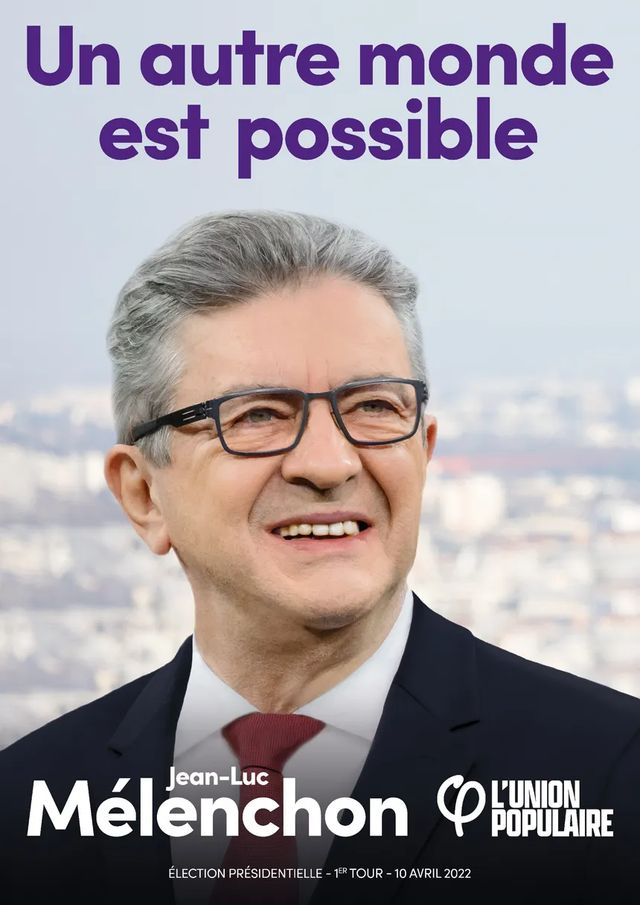
The flyer here is remarkably similar to the one Nathalie Arthaud’s team produced. A close-up of the candidate, looking above the shoulder of the audience, towards the future, although, weirdly, here, the candidate looks to the right, but that might be more a technical issue of not reversing the picture rather than a deliberate choice. Visually, I find this poster hilarious: the forced smile that is supposed to incite optimism and the idea of the future (which should pair well with the slogan “another world is possible”) instead makes you wonder what he ate to make that sour face. Fish that went bad? Too many prunes?
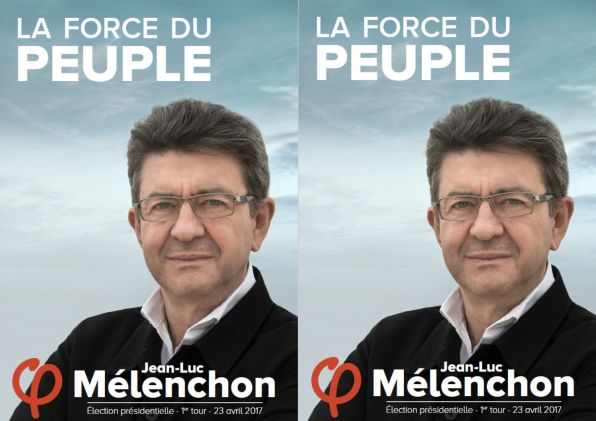
By contrast, his 2017 poster was much better:
Strength, determination, calm: those are all great qualities to project, not “OMG find me a bathroom now”.
Interestingly, or remarkably, as you want, the red that is normally associated with his party has completely disappeared, perhaps in an effort to appeal with the people who are fleeing from the Socialist Party (polling at a maximum of 3%) and the Greens (polling at 4.5%–under 5%, parties don’t get reimbursed for their campaign. It’s out of pocket, which almost sunk the Republicans after the disastrous 2019 European campaign, after they limped above the 8% mark, while already under a heavy debt burden from the Sarkozy years–all the French major parties have huge debts, including the Le Pen party, which owes millions to a Russian bank, hence the weird line MLP is playing with Putin).
I mean it’s not just that the closer picture and angle is not great with the red tie combination, it’s also the background that’s not contributing, and the smile. The. Smile.
My flyer is slightly different than the campaign poster: it has some verbiage under the picture and by virtue of contrast, the picture looks even more out of whack in terms of exposure than it does here. There are also a couple of campaign promises points below, none of which are particularly defined, but they underscore the priorities of the party, with three particular items in bold blue letters: real gender equality, send France to an alternative ecological path, and become a non-alined anti-globalization nation. I find interesting that the proposal of changing the constitution to the 6th Republic is not in bold here. It’s a left-wing proposal that’s been fairly popular in the left wing of the Socialist Party, mainly because the 5th Republic’s constitution is the brainchild of De Gaulle, but it’s not a proposal that has a significant traction outside of the left.
Also, render unto Caesar and all that: the guy has some guts. On the back of the flyer that came in the mail for us there is another picture. At first I thought that was a better picture than the front one, but no: it’s the cover of his memoirs/political pamphlet, published with Seuil publishing. Under the guise of a flyer the state distributes for free for the parties, Mélenchon sells his book. I’m not sure it’s moral, but it’s apparently legal, dear reader.
The picture sort of takes the cake though: when I got it out of the enveloppe we received for the vote, I laughed out loud. It’s already increasingly hard to take seriously a guy who uses holograms and odor projectors for his meetings, I…
I don’t know what to tell you. Sometimes marketing and consultants are not great (see the McKinsey consulting scandal Macron is currently dealing with).
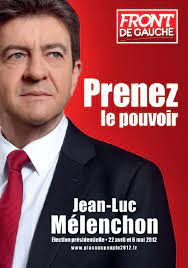
Also, side note, this picture looks eerily like the one he already used for his 2012 poster, but aged and cut off. It worked way better in 2012–well it worked better if you were going for the revolution and class clash:
Look, he CAN actually smile! or at least look like he is determined and not whatever the first poster above is.
Election flyers time! Go here for part 1, the Communist Party flyer.
This week, the French are voting for the first round of the presidential elections. It’s coming at a moment no one could have predicted as this tense, with Europe trying to wean off of its energy dependency as Russia is invading Ukraine. This has been one of the foremost issue in the recent weeks, all but eclipsing the rest of the election topics, and the corollary of gas prices has been at the forefront of the campaign (which is, in all honesty, a refreshing change from the usual fare of immigration and public safety).
Here is my readout of the the posters of the election.
This next poster could not be further from my personal political beliefs, but it’s also one that has things to say, if only as a cautionary tale. Let’s see if you can guess the party’s leanings:
So, I should say that this was kind of a trick question: in France the blue is for conservative parties, and the red is for left-wing parties. This color-coding is very old, and dates back to the post-World War I era, when the elected chamber was heavily peppered with veterans. French soldiers wore blue pants and jackets in the trenches, and a deep blue coat for ceremonies (with very visible red pants), so the elected chamber was nicknamed “blue horizon”. The government subsequently nominated (France had at the time a similar constitution to Italy now, so the Chamber’s dominant party or alliance of parties determined who was to be Prime Minister, while the President held a largely representative function and was not elected by direct universal suffrage) was led by Clémenceau, a war hero, and was an assemblage of right-wing party later known as the Nationalist Bloc. Thus blue came to be associated to the French equivalent of the US Republicans today, and the red, for the socialist and communist conferences, were used as left wing colors. In 1920, at the Tours Congress, the French SFIO, which until then had been a single party, split into the Democratic Socialist Party, and the Communist Party, and they adopted respectively pink and red as colors in the later part of the century.
So, considering blue as a conservative color, deep blue is the color of very conservative parties in France, and in this case a nationalist party, the Rassemblement National (formerly the Front National). A brief history (okay not so brief) of the FN:
It’s almost 8pm when the Citroën DS of President Charles de Gaulle leaves the Elysées Palace on a warm and dry summer–in fact France is undergoing a major drought, following an exceptionally cold Spring. At 8:10pm, on a roundabout of Le Petit Clamart, a town Southwest of Paris (near Versailles), a man standing near his SIMCA car waves a newspaper. Unbeknownst to the General, his wife Yvonne, their son-in-law Alain (who is also the General’s aide de camp), the chauffeur, and the secret services agents following in the next car, this is the signal a band of terrorists from the OAS was expecting. The Secret Army Organization, a terrorist organization essentially formed by a coalition of organized crime bosses, and army officers, was dead-set against Algerian independence. Despite their work to undermine it, bombing and attacking indiscriminately Algerian groups and French government positions and officials, independence had happened earlier that summer, in 1962. The year before, they’d frustratedly watched the Algiers putsch attempt fail when the military commanders of Oran and Constantinople had stayed loyal to De Gaulle (a French resistance hero, and a revered war commander of the French Free Army during WWII).
As my father tells the story of the putsch, De Gaulle placidly told the anti-independence “I understood you,” and then threw everyone in jail. It’s a tad bit more complicated than this (sorry Dad!): De Gaulle’s government had heard about the putsch through the secret services. The day of the putsch, after a message announcing the military had seized control of Algiers awoke the city at 7am, De Gaulle had a general and several other officers and civilians compromised in the Coup arrested. The next day, in a foreboding move that Juan Carlos will steal in 1981 in Spain, De Gaulle appeared on television at 8pm, in full 1940 uniform and regalia (including his multiple medals he’d already earned before and during the war, as De Gaulle was a very good military strategist). He called onto soldiers and civilians to stop the Coup, stating that the quartet of generals and their officers who had seized power were only the face of a secret army of fanatics who saw the “Nation and the world [only through] their distorted delirium.” He concluded his call with the outcry: “Frenchmen, Frenchwomen! Help me!”
Thanks to transistor radio, his call was heard all over Algeria, and conscripted soldiers, the real unsung heroes of the failed Coup, rose up against their commanding officers. Just like in Vietnam, many already questioned the legality of what France called “a special police operation,” especially in the face of increasingly hostile world coverage. So when their C-I-C asked them to stand down and prevent the fall of the Republic, conscripts heard him live. And answered in kind.
This was the De Gaulle that the OAS was attacking–not the one who would be revealed later to have facilitated the rise of his own private militia, the SAC (Service d’Action Civique-Civic Action Service) through his secret services’ careful management of organized crime in Algeria. De Gaulle had a mythical status, which only grew after the attempt on his life.
The OAS shot over 150 bullets that day, but fortunately for De Gaulle and his entourage, the shooters were either poorly trained or the drivers were very good, and none of the De Gaulle family members died. The front tires of De Gaulle’s DS were blown, but thanks to the world-famous hydraulic suspension Citroën is known for, the car stayed on the road and was able to drive away to the Villacoublay airport, its original destination. De Gaulle and his wife were saved by the quick eye of their son-in-law, an army colonel, who reportedly shouted to his father-in-law “To the ground, Father!”. As a side note–it’s not the first time De Gaulle was under fire: he famously stayed upright and calm as snipers were raining bullets on the Te Deum mass he’d called for in Notre-Dame, at the end of WWII, so his reputation as being fireproof was nothing new, but stories were immediately born about him staying upright in the car, which isn’t true. If he’d stayed upright, he would have been killed–but thanks to the quick-thinking of his son-in-law, he dodged to the ground and was saved. Another legend/potentially true but really impossible to verify was born that day around Yvonne, De Gaulle’s widely invisible wife, normally, (who was way more discreet than Mamie Einseinhower, so this story is quite out of character for her). Reportedly, as they arrived at the airport, Yvonne was only worried about one thing, the chicken. Chicken is the English equivalent of “pig”: it doesn’t just mean the animal, it’s also a slang for cops. “Did they shoot the chicken?”, bellowed Yvonne. No, answered the secret services, we are all well and good–but she was actually speaking about real chicken, the one they’d had delivered frozen from Fouchon, sitting in the trunk of the presidential car. The OAS operation was dubbed “Charlotte Corday,” by the way, from the anti-French Revolution activist who murdered Revolutionary and French Republic Founding Father Marat in his bath (“They couldn’t corrupt me, so they murdered me,” he supposedly wrote/said as he died), so you can probably gather where the democratic system was going after De Gaulle’s assassination, in the OAS’ wildest dreams.
Those officers got caught, but the grumbling opposition, built on former paratroopers (most of whom were guilty of torture and genocide in Algeria, but never saw the front of a La Hague tribunal, because France), continued through political groups like the GUD (Group Union Defense) or the ON (Organisation Nationale/National Organization).
In the late 70s, these people saw with increasing alarm the rise of François Mitterrand and his socialist party (ah, the good old red scare that justifies every fascist attempted coup, including the possible support of the CIA to the Algiers Coup in 1961!). Before the 1973 legislative elections, they started to organized more formally, but it was after Valérie Giscard D’Estaing’s failed reelection that they started on the national scene for good. Not that they were very happy with VGE to start with–but his loss came with the rise of Mitterrand, and that was the scarier part.
Le Pen was a former paratrooper, who was never tried for torture–but there is circumstantial evidence he participated in special operations with the goal of kidnapping Algerian civilians. Over the years, he has widely denied these allegations, benefitting from anecdotical stories such as the fact that he was one of the few officers who, in Algeria, had Muslim enemy fighters buried with Muslim rites (allegedly, Krim Belkacem, one of the leading figures of the FLN, the Algerian freedom fighters group, told him in 1970 that he escaped assassination attempts only thanks to his attention).
What’s certain: JMLP was born into a blue-collar family, and had always had a reputation for trouble. In high-school, he got expelled for fighting and reputedly lost his right eye in a fight. During his years studying for his law JD, he reportedly was so flamboyant and combative that he was asked to step down from his VP position in the Student Council.
The independence of Algeria primed him for the waiting arms of the extreme-right organizations of France, and he became increasingly close, before and after it, to OAS members.
JMLP is obsessed by French history, and he doesn’t like the path the Republic is on, especially the rise of postcolonial immigration. A few examples: in 1963, with a former French volunteer of the Waffen-SS, Léon Gaultier, he opened a music business specialized in editing military music and historical speeches (you can guess which type of speeches he published). In 1972, some members of the Order Nouveau (New Order, a sinister nationalist and antisemite organization close to former pro-Vichy and Waffen-SS veterans), impressed by his publishing work, asks him to become a candidate for the legislative elections in a newly founded party the National Front. Shortly thereafter, JMLP seized control of the group.
Le Pen is a talented public speaker, but the specter of the Vichy Regime is too close still, and his party stagnates below the 5% scores. On November 2nd, 1976, a bomb destroys part of his Parisian apartment. Marine, his youngest daughter from his first marriage, is 8, and she is traumatized.
This is relevant because it’s always been my theory: JMLP doesn’t believe half of the outrageous stuff he spouts. He is a troll. He relishes the attention, and, like Trump, he has very little core political convictions–his political sense is mainly built on several core beliefs: no one says no to JMLP, he is a born-brawler (think Ray Kelly, former commissioner of NYC and former Marine and boxer), JMLP is unpredictable, there is an international conspiracy against the sovereignty of nations, and democracy is bad because it is not willing to get its hands dirty to help him rise and protect everyone, Everyone Is Out To Get Him, Authoritarian Regimes Are Good, Weak People Should Die. The rest is just a natural deduction of this. He is basically a fervent follower of the idea that the strong should govern and the weak should die, but he will also sell mother and father to get to the spotlight. That makes him a great demagogue, but not really a man of convictions.
I also don’t think JMLP ever expected to become president–like Trump he just enjoys the personality cult, and the ability to say uncensored bad crap. Don’t be mistaken–he is a Bad Dude (TM), but his over-the-top personality long stopped being directed at taking power. He just likes to troll.
His daughter, on the other hand, that’s another issue altogether–first-of-all, her world is very different from her dad’s: he lived through the 1976 bombing as an adult, and took it as a badge of honor, as a former veteran who had willingly conscripted to fight decolonization three times would.
She lived this as a helpless child, and Marine Le Pen does not do well with helplessness. (None of the Le Pen do). Her niece Marion Maréchal (her older sister Yann’s daughter) is even worse–she grew up in a widely reviled family, a wealthy one (Le Pen started paying the high fortune tax in France in 1982). She is basically third generation frustration, hatred, and nationalism, and that is never a great combination.
Back to Marine LP. When her dad stepped down (under pressure) from the party, it was mainly because the party was now steadily making scores over 10-15%, and stagnating. Some leaders in the party saw the Le Pen patriarch’s association with former organized crime bosses, and generally neofascist rabble, as disquieting and an obstacle in the rise to power of the party, especially in the context of both a reckoning with Vichy and the reality of the French resistance, which starting in the 1980s was finally depicted as it always should have been–a minority movement–, and the work to unearth Algerian archives the newspaper Le Monde started doing in the early 2000s.
Le Pen Sr had led the party to an unexpected second round in 2002, though unintentional (the left-wing candidate, Lionel Jospin, was uninspiring, fairly socially conservative, and bad at campaigning), but his trolling now kept the Front from power, because the party kept hitting the Republican wall, named not for the US or French conservative parties, but for the general, unspoken consensus that no Le Pen was ever to hold the top power position: any candidate who ended running up against the FN in the second round of whatever elections from top to bottom was the candidate *everyone* should endorse, even if that meant voting against your own conviction.
The widely unspoken agreement was: No Pasaràn. They Won’t Pass–the anti-fascist outcry of the Spanish Civil War in the 1940s.
More prosaically, opposition to the FN also led the French government to switch back to a majority vote (winner-takes-all) after a brief proportional election (each party gets MPs proportionally to its scores) in the early 1980s. Interestingly, Mitterrand is the one who made that change, ahead of what looked like a hot mess of an end-of-term legislative election. He walked it back immediately after it resulted in the election of 35 FN MPs.
This “bold” personality that had led Le Pen to power now was a hindrance, and combined with outrageously bad management in the few towns the FN could win in the 1990s, led the party to oust him, first from power, then to force him into retirement and out of the party in 2015.
His daughter was named as his successor. Marine, also a lawyer, has almost always held a job in politics, with one single-minded focus starting in the early 2000s: clean up the party, sever the ties with organized crime and former OAS officers, kick out antisemites, skinheads…Generally clean house and throw out the guys who screamed FASCISM. The FN was now a respectable party, much like the pretense of the alt-right white supremacist Richard Spencer.
This strategy led the FN to a number of town administrations in the 2000s, which they still hold for the most. It also brought Marine to a third place at the presidential election of 2012, behind Hollande (Socialist Party) and Sarkozy (the right wing incumbent)–but it should be underlined that she only placed third (with the highest historical score for the FN) through a combination of the Republican Wall, and the fact that Sarkozy campaigned so far to his right that he seemed somewhat virtually indistinguishable. Sarkozy had overstayed his moment, shocking the wider voting public with harsh anti-immigration declaration, and leading even my moderately conservative (center-right) dad to vote for the Socialist candidate, Hollande.
In 2017, Le Pen Jr rose to the second round, and that’s when things started to be more complicated: under the weight of the 2008 financial crisis (which Europe was still not recovered from, to some extent, in 2015-2016), and the combined new respectability and general apathy of left-wing voters, Le Pen passed the mythical 15% bar no one in her party had ever passed at a national election.
But then, she fumbled her answer in the televised debate, much like Nixon made a piss-poor performance against JFK, and got confused between two issues. It’s not so much that people voted for Macron, it’s just that her performance was so dramatically bad that the Republican Wall survived one more election, and she lost. There was also a strategic change in the way the Powers That Be dealt with her party: up until her, the conventional wisdom had been that any attempt at judiciarizing the known links of the family with more or less unsavory elements, or any attempts to look into the party finances, or possible organized crimes links, would result into the triumph of JMLP who would emerge as a martyr.
This strategy having shown its limitations, the omerta was lifted in the early 2000s. It led to JMLP being declared ineligible, and 6 judicial affairs emerging during the 2016 campaign. This, combined to her bad public performance, led to MLP losing. Unfortunately, almost despite herself, she also emerged with a 30% score at the second round, which was historically unprecedented and showed the erosion of the Republican Wall–well and also the fact that no one was really that hot for Macron, whatever he thinks. Macron is a technocrat–someone who’d never held an elected public office position before he ran for president, and that’s a species that’s increasingly hated in Europe.
Objectively, newspapers were right to be worried that MLP would be elected on the first round (something that’s never happened in French history but is technically possible if a candidate has more than 50% of the vote). Unfortunately for her, high abstention rates worked against her. I know, it’s not intuitive, but in France the alt-right has a solid youth and blue-collar base. Trump was elected mostly by suburban white people. Until late in the 2010s, these people in France did not traditionally vote for Le Pen if they were salaried employees. Only independent contractors voters voted for her. But now, Le Pen had managed to present the image of a modern woman, taking a leaf from Meg Thatcher’s book, and that strategy worked with the youth in France, combined with an increasing structural unemployment of youth (France has one of the highest youth unemployment rate in the EU).
Unfortunately for her, a campaign that was about as interesting as a dead fish, combined with the warning shot that Trump’s election was, combined to make her score lower than it should have been, and Macron got elected.
For the 2017 campaign, MLP is running into a bunch of unforeseen issues: the Ukraine war has transformed Macron into a war leader–and most Western democracies LOVE their war leaders, especially if it’s for a cause as popular as Ukrainian democracy, and against Russia. Another issue is the possible Russian financing of her 2012 campaign, and her relationship with Putin, which is now a poisoned gift.
And finally, a public figure has emerged at her right–it’s no secret that a bunch of former leaders of the FN (now RN) have been disenchanted with Marine’s “polished image” strategy, and see her moderation as a hindrance to their road to power. Amongst them is her own niece, who has risen to power meteorically, becoming the youngest member of parliament ever when she was elected at 22 in the lower chamber, back in 2012. Thus enters Eric Zemmour, the devil-she-must-deal-with, and who is making her look like an angel by comparison. He polled way ahead of her at first, but he seems to lose steam as the campaign is progressing, and now the second round seems to predictably be slated to be her vs Macron.
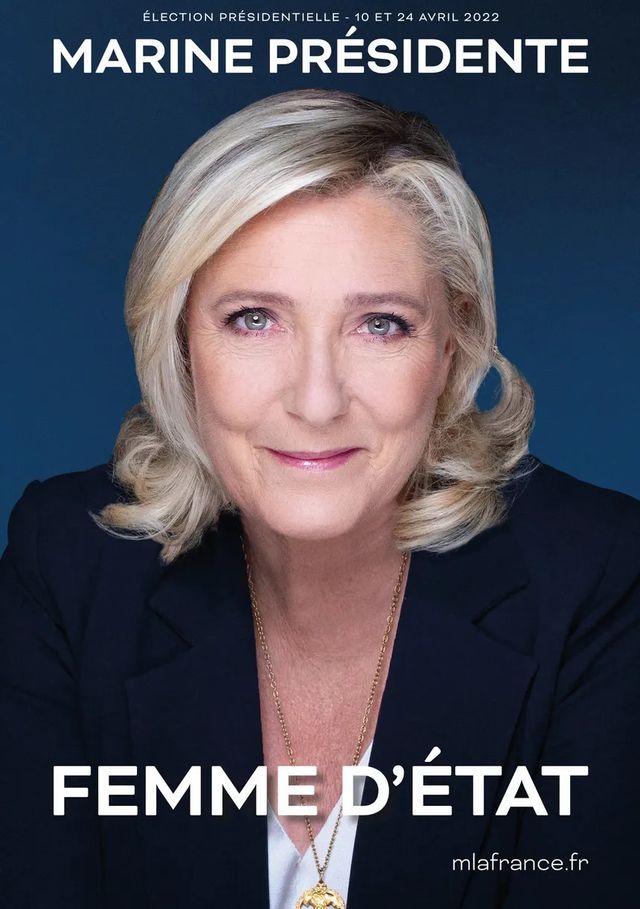
In terms of poster: she is doing a hard Thatcher sell here. Macron has been criticized for his relative youth and incompetence–she is showing an opposite side. It’s a sober poster, with a unified dark blue background, by contrast to the dark blue, much more informal poster of the first round in 2012 (which was strangely similar to a Sarkozy one, btw), or, God forbid, the campaign aberration of 2017, which showed her sitting on her desk with a short skirt. I have no idea who thought it was a good idea to choose a second round poster like this, but she quickly discovered what showing a “more vulnerable” or “sexy” side implies for women in politics: this poster, against Macron’s poster of the time, made her out to be too young, strangely younger than, and more incompetent than the guy who was running against her, potentially the youngest president ever, and also someone whose only background was holding a ministry and studying public affairs. This second round should have been much harder for Macron, but this communication mistake combined with her debate fumble made it a slam dunk even for someone as unappealing as Macron.
She’s learned from her mistakes, and she has thatcherized her image considerably here, which is smart (hey, I don’t make the codes, blame my patriarchal home country for it). Even the choice of a discreet gold pendant and a straight face contrasts with the disaster that was her weird tilt on the 2017 second round poster. The white shirt below her dark blue tailor helps bring in a nice contrast, but it also veers attention away from her chest, when her 2017 poster over-sexualized her. It’s a boring poster, and she is selling the respectable female politician hard, and playing the “responsible woman” card super hard, but contrasted to the disaster that is Macron’s poster this year, it finally makes her look like the experienced politician she didn’t look like in 2017.
Never underestimate Marine Le Pen. Many have made this mistake before, even finding her nice in contrast to her dad.
But when fascism knocks again, it’s not going to be wearing Stormtrooper uniforms, as goes the popular meme.
It’ll wear the suit of a formerly-chain-smoking-survivor-female-politician, who’s likely going to survive Eric Zemmour against all odds.
Again, Le Pen is not the imbecile her niece makes her out to be. She might have mastered the art of saying nothing and vacuous political speech, but she is not dumb.
Let’s see if her strategy of respectability bears its fruit–she is also playing her skin here, as her niece’s desertion to Zemmour shows.
This week, the French are voting for the first round of the presidential elections. It’s coming at a moment no one could have predicted as this tense, with Europe trying to wean off of its Russian energy dependency as Russia is invading Ukraine. This has been one of the foremost issue in the recent weeks, all but eclipsing the rest of the election topics, and the corollary of gas prices has been at the forefront of the campaign (which is, in all honesty, a refreshing change from the usual fare of immigration and public safety).
Now, I’m going to give out my age here, but my first election as a voter was in 2002. Twenty years later, the front runners are more or less the same, but with a generational (and talent) gap. Polls are giving Macron, the incumber, and Marine Le Pen ahead, followed closely by Jean-Luc Mélenchon (who is actually the only one in this election who is not a somewhat new face from the early 2000s).
Before the war in Ukraine, Macron had already heavily played his hands so that Marine Le Pen would be his opponent in the second round of the election. As a reminder, French presidential elections are in two rounds: the first round determines who amongst the dozen or so candidates goes onto the second round, and the second round is about who is the best of the two. A few additional rules are of interest: to run for the presidency in France you need to be French (duh), at least 18 of age, be a legal voter, never have been found guilty of a crime, and be of “good moral standing” (although that’s not defined). You also need, and this has been the case for a while now, to find at least 500 elected representatives to sponsor your candidacy–this was explicitly implemented with the goal to avoid prank candidacies, but this year it kept left-wing former minister of justice and MP Christiane Taubira from running.
The French electoral system recognizes what it calls “le vote blanc”, white voting, or the action of not selecting either candidates, but it also does not provide a minimum percentage for an election, nor does it count the white vote in any significant way–a candidate could theoretically be elected with only 5% of eligible voters, and, let’s say, 65% of white vote as well as 30% of abstention, although that has never happened for a couple of reasons: one is that voter registration is now automatic in France, IDs are free of charge, and every eligible voter on the list receives a packet with election dates and election candidates. Each packet contains a paper bulletin (with only one name on it, none of the complicated card systems the US has), and flyers from the candidates presenting their programs. For the national elections, those are always, by law, in French, but since the 1990s, some candidates to local elections have chosen to have their program translated in regional languages (particularly in Corsica and Alsace, regions where local dialects are still very vibrant).
These are the basics of the presidential elections.
Now onto what really interests me here: the flyers!
I have just received them (as an eligible voter living in the US, I am voting in Jersey City, as my district–the Northeast and Atlantic Region–is dependent upon the New York Consulate for all things but vital statistics. I am not going to complain though, some people have to drive upwards of 5 or 6 hours to vote).
Here is my readout of them, an exercise I do every year with my students (or on social media), and a little context for each.
I am not a communication specialist, but I have a background in history, and I have taught French for marketing purposes before–I am also a pop culture aficionado and a literature and language professor, so I’d like to think that while I am not an expert, I do have some expertise in related domains. Those are not in any particular order of preference, in terms of politics, they are ranked by how well they’ve attracted my eye, or how good they are compared to previous campaign posters/flyers. I will also state right away that I disagree with most of the things written in this article, where a French public radio gave these poster to a communication consultant, and although her insight is valuable, it’s also short-sighted in a number of ways (I do have a tendency to be very frank, that’s my Alsatian side), not the very least because it’s written from the point of view of someone who is not a historian, and someone who is very Paris-centered in her analysis (her contention that one of the candidates speaks French badly, while the transcript is riddled with grammatical mistakes and her way of speaking is really not that great, grammatically speaking, stems not from an objective description, but from the fact that the poor chap happens to have–o tempora, o mores–an accent. How dare he sound provincial!).
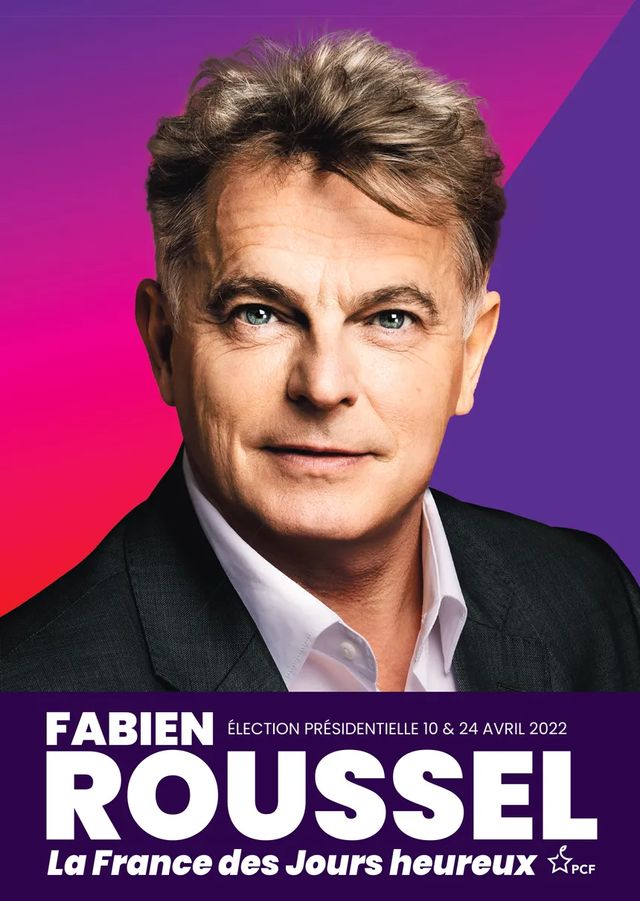
First up, Fabien Roussel. I’ll put the street poster below (the flyer looks exactly the same, and the quality is better than what I could do taking a pic with my phone). I’ll give you a few seconds to guess which political party this person belongs to.
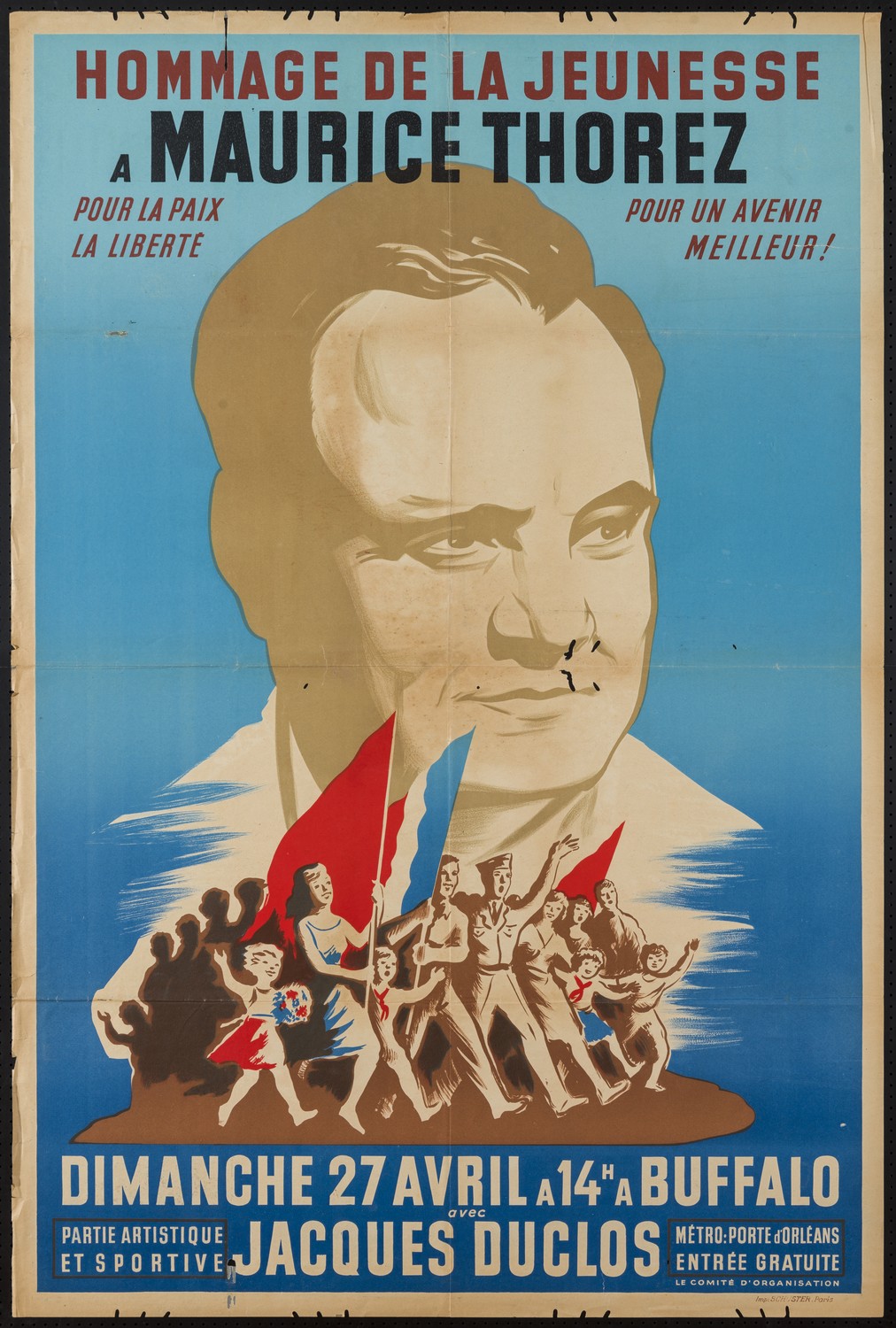
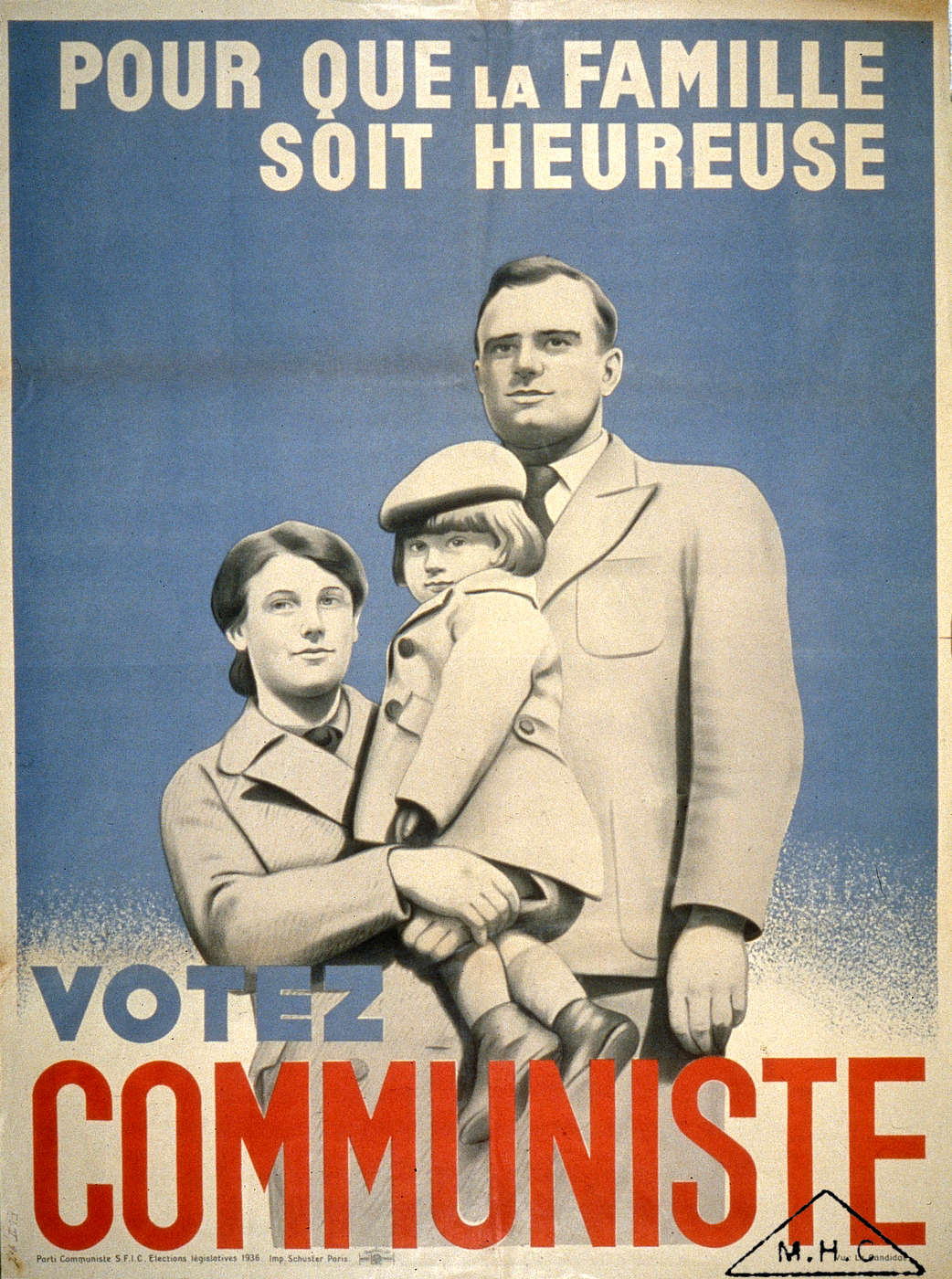
If the small lettering in the bottom right corner did not give it away, this is the Communist Party candidate (PF= Parti communiste Français). A couple of notes and first impressions: at first viewing, this is not at all like the usual fare for the PC, and it doesn’t especially scream “The People” (which our consultant rightfully noted, but she missed the historical reference of the slogan). The PC’s historical color palette has always been, of course, a deep red. The French Communist Party does not use, and has not used, the sickle and the hammer symbol since the 1970s or thereabout, after the revelation of Stalin’s crimes. It has used the terminology PCF, with the French added, ever since that time too, to distance itself from the Soviet crimes. It was an abundant symbol in the 1920s, and the 1930s, but after the war posters essentially revolved on Maurice Thorez, head figure of the party, and an extremely popular one at that, and on symbolic “worker figures”. Soviet art is, and has always been very color-coded and geometrical, so the PCF was in this line, with very bright color and simple lines. Even though the posters switched to photography in the current era of politics, they kept that simplicity and geometry until roughly the late 1980s. The use of photography as a persuasive mean has made them a bit messier, but this poster above goes back to a long and cherished tradition of the party, although it differs starkly in the color-code it uses there, with a fuchsia and purple dominant background.
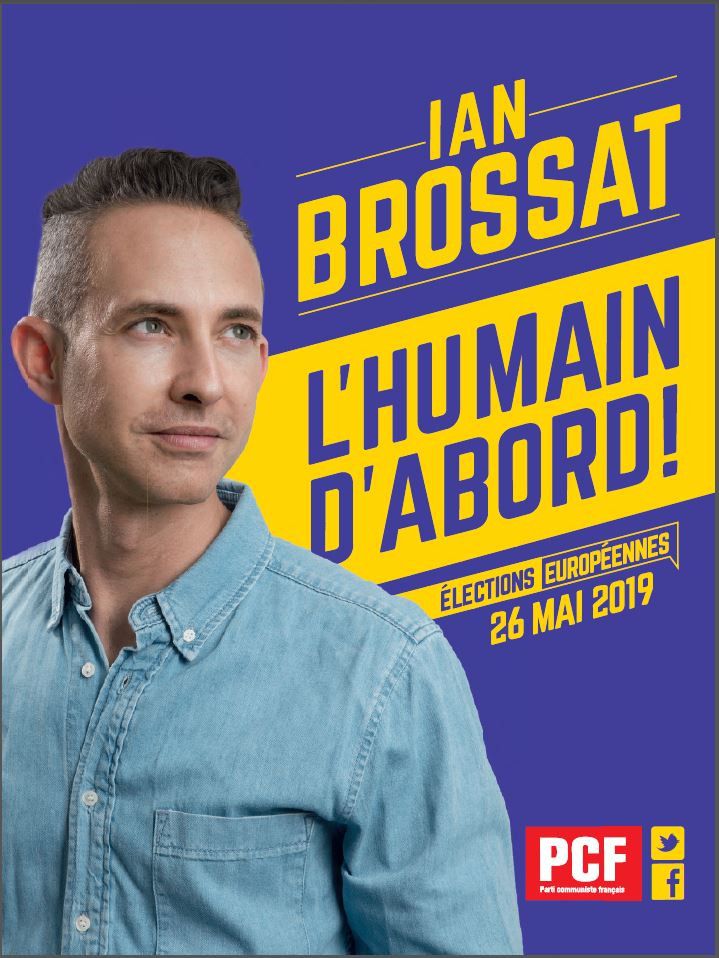
For reference, here are a couple of posters from different eras (you can toggle between the different eras by moving the vertical cursor):
Note that the modern era, 2019 poster looks awfully like AOC’s campaign poster for her first election.
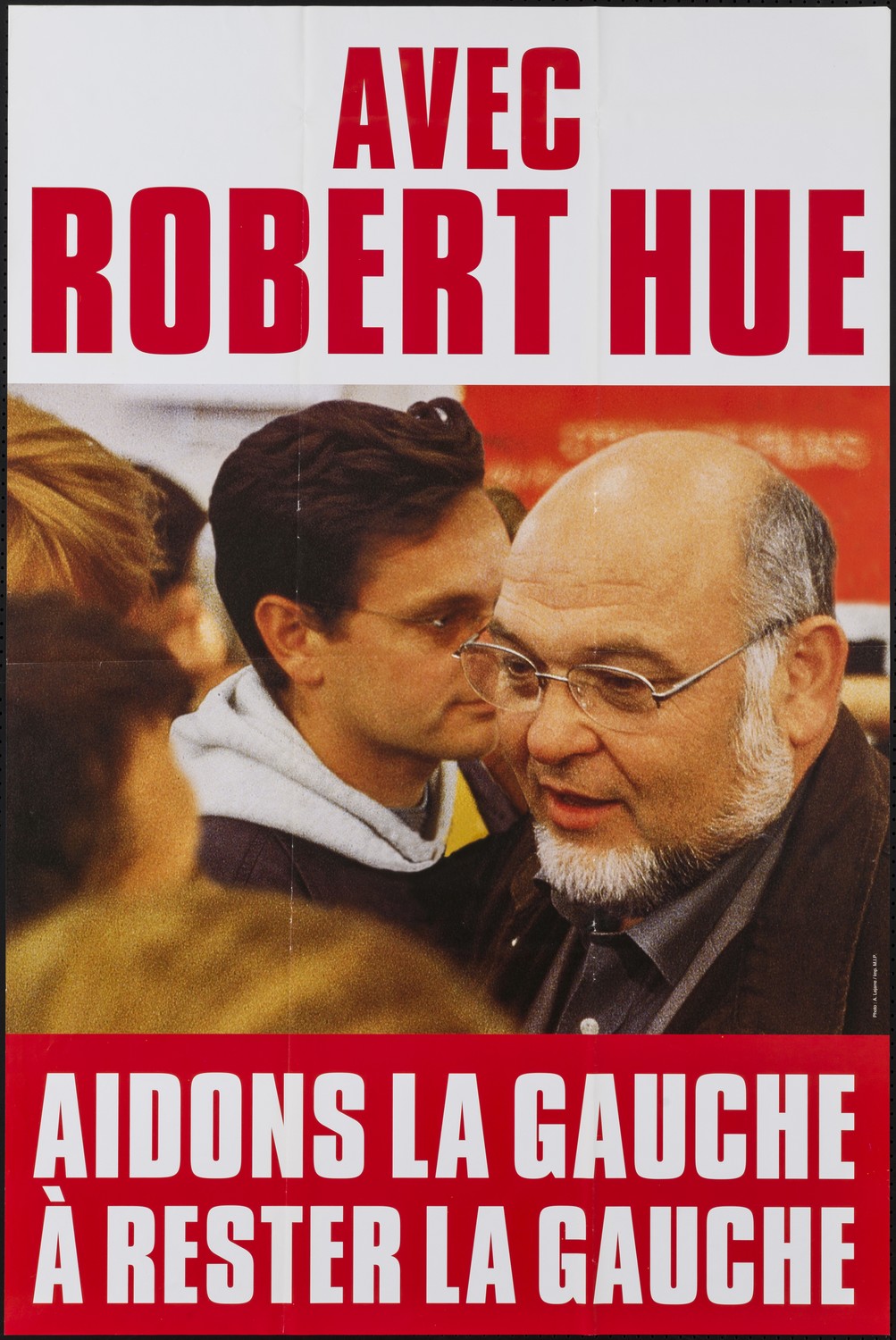
Another note: the PCF was the king of personality-cult type of poster (see this page for a more extensive comment on this, as well as a couple of references of books on the subject of Soviet-era PCF flyers), so it’s not entirely out of character for them to have a poster centered around a person, although the historical candidate of the 1990s, Robert Hue, chose often to have a crowd around him, but that also corresponded to his jovial and communicative character–Maurice Thorez had crowds below him, as any respectable cult-leader would. No crowd here, but the poster’s full face reminds me of the full face, single-figure posters of the 1930s-1950s, often featuring families. The intent is slightly different, as these would often look above the audience to the future, but it wants to be hopeful. This corresponds to the slogan, La France des Jours Heureux, which any respectable French historian will immediately recognize as similar to the 1936 Left Front (le Front Populaire) sort of vocabulary.
The suit–well the suit doesn’t scream blue-collar worker (and we will see that other popular, left wing parties use that to their advantage), but I disagree that it screams antithetical to a popular (populist?) imagery.
First-of-all, once and for all, can we dispel the notion that all politics can do the “Bernie Sanders at the inauguration look”? Imagine if Michelle O or AOC had shown up in old pants, a North Face winter coat, and homemade mittens at the inauguration in 2016. The press would have gone WILD. Every female politician (except Arlette Laguiller in her later years, but that’s a debate for another time) knows that if they show up in anything less than a suit, they’ll be crucified–if you have a medium handy, ask Meg Thatcher what she thinks of the idea that a woman can be in politics without heavily coded clothing.
Second-of-all, I think it’s presumptuous and classist to assume that someone who is poor is necessarily badly dressed–it’s about as classist as the numerous posts I saw during the Yellow Jacket movement in France that mocked the strikers for having iPhones. There is this thing called credit y’all. I own an iPad Air, an iPhone, and an SUV, all bought with credit cause I don’t have that kind of money. Note that Fabien Roussel is the son of a L’Humanité journalist–the newspaper that was the PC official organ, and is owned in a coop by its reporters. He certainly isn’t dirt poor, and there is something to be said for having an actual blue-collar worker at the head of the PC. But by the same token, he isn’t a business CEO, and I actually find annoying the idea that someone in a good suit cannot possibly be blue-collar. My grandpa, a mason and stoneworker, rocked his suit, y’all.
The gist of it: it’s a modern flyer that also calls back cleverly to previous design codes of the party. Its slogan is retro without being nationalistic retro, although it’s perhaps too cryptic at this point. Not that I would ever vote for this guy, but he manages to make himself look warm, and call back to an era of social prosperity where his party helped chip away at inequality, so that’s always great. Honestly, I pick this one as my top contender for best flyer, not because it is inherently great (it has many flaws, one of which being that it is way too complicated to read for a political poster), but because this year all the others are so dull and lifeless, it’s going to take all of my willpower to go through the flyers and programs, so I give this one props for being actually interesting visually.



 The Traveling Scholar | AC Sieffert, PhD