There are several pedagogical uses for blogging: it gives students a space to have their own voice, lowers the stakes for output, and helps them write, supplementing class exercises.
I have used blogging as an optional, bonus point device, and as a part of class preparation/debrief.
Case study one: blogging for bonus points (Cornell University, Fall 2016)
The first option, bonus points, prevents the usual “can I do extra work to make up for my exams?” to a certain extent, and presents the advantage of allowing students who are not quite vocal in class to participate in a conversation. The requirements of the rubric depend upon what the pedagogical goal is.
In the case study below, the goal was to get students to research French music, while interacting with each others, so the rubric allowed for three criteria: frequency of participation (twice a month minimum), type of interactions (one blog explaining what type of music the student liked, and giving an example, and another interacting with a classmate, and exchanging tips or suggestions on how to find music, what singer their classmate could like), and length of posts (100 words at minimum).
To get students started, and since Cornell does not have a French and Francophone music website, I put together a forum with threads: the forum had an introduction page explaining resources to listen to French and Francophone music, and then each style has its feature page on the thread function (note: Cornell uses blackboard).
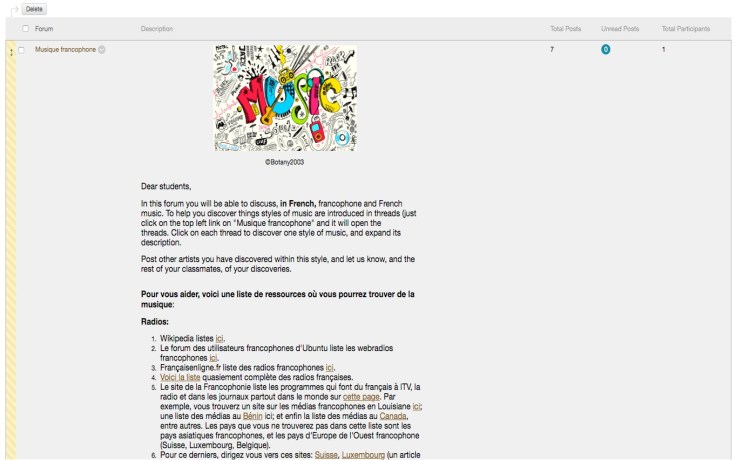
The blog was deliberately set up with a short English introduction, and then switched to French, trying to be as close as possible to immersion.
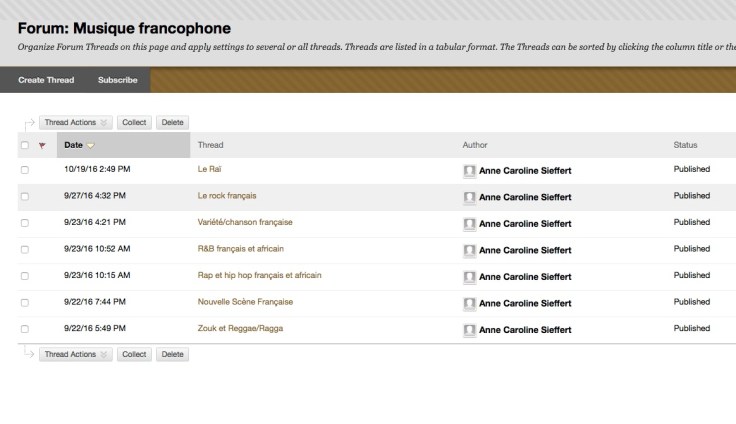
Post threads were then subdivided, after the introduction page, into several genres of music, allowing the student to navigate to the one they liked, or giving the option to explore all of them. Users acted differently, as the site’s statistic tracking page shows: some students were focused toward the completion of the exercise, going directly to one genre, and staying there. They posted about singers they were already familiar with, and their interactions. About half of the users explored, and some stated they had discovered music.
At the end of the semester, I asked students to give me feedback on how the blog could evolve in the future, and I was surprised that many stated they wanted this to be a more integrated part of the class. Some also wished to have literature forums–an interesting counter to the popular wisdom that foreign literature does not interest American students.
Case study two: blogging as a class preparation/debrief (Cornell, Spring 2017)
In this second case, I set up a blog to be an integral part of the class. This class is focused on writing, and the outcome of this exercise is to give students the opportunity to produce writing with low stakes, and to be prepared for class time efficiently.
Each blog includes questions, set up as prompts to help students understand some issues, but students are also encouraged to go off on their own, and make up their own questions, as explained in the opening instruction of the blog.
The particular week the example is culled from included reading a chapter called “What One May Consider Laws and Order Amongst Savages” where Lery discusses society, and ownership, amongst the Tupis. Students were asked what they thought of when they heard “law and order.” The blog, in this class, can be completed before or after class, depending on how busy the students are–before class, I print out an outline of each students’ contribution, so I know what they had questions about. After class, the blogging serves as a debrief on what they thought of during class, but did not get to mention in class because of time constraints.
During this particular class, discussion rolled on several points: how the four last decades had changed what the words “law and order” meant (we talked about Reagan’s use of the word, Bill Clinton’s “Three Strikes” federal law, the American Constitution’s inspiration), Nature versus Nurture (we talked about Lery’s vision of “natural men,” and how different it was from Rousseau’s ‘man is born good, it is society that corrupts him’, and the idea of “the Good Savage” in European literature).
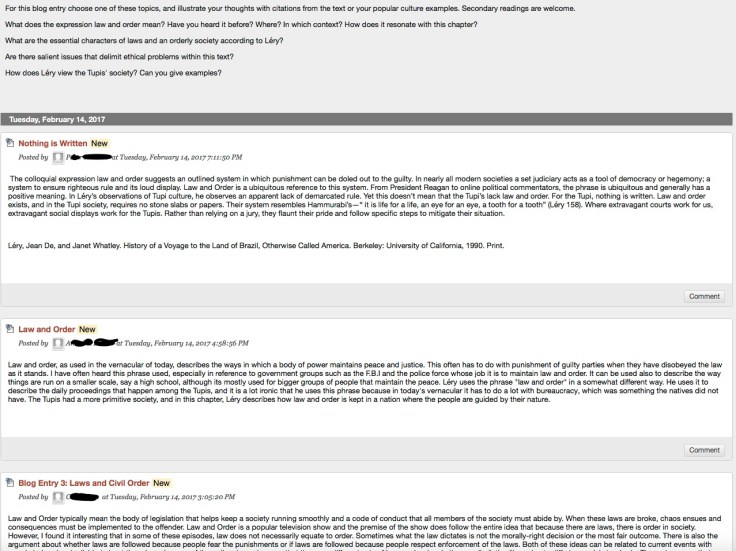
I find this format very productive: so far I have never had a silent class, and many remarks came from the blog.
 The Traveling Scholar | AC Sieffert, PhD