Again, for a crop of students who are immersed in visual aids, these are set up to help them visualize information, or produce texts that are linked to a specific format, requiring them to think in terms of length, brevity, information to convey or not, etc. In the second case, this is an exercise in some ways similar to having students dub videos, or write subtitles in French or in English of a short video–they have to think of what information to convey given the shorthand format, and where to convey it best in regards to the image.
For the earlier example of visualizing information, mapping a text includes several possibilities–it can mean mapping themes and their relationship to each other, but also, more simply, mapping the trip of heroes in an adventure novel so students can see the relationship between text/speed of travel and rhythmic narrative. In language classes, mapping, i.e representing in maps (unlike mapping a text), can be used to produce collaborative maps, which are best for times in the language lab.
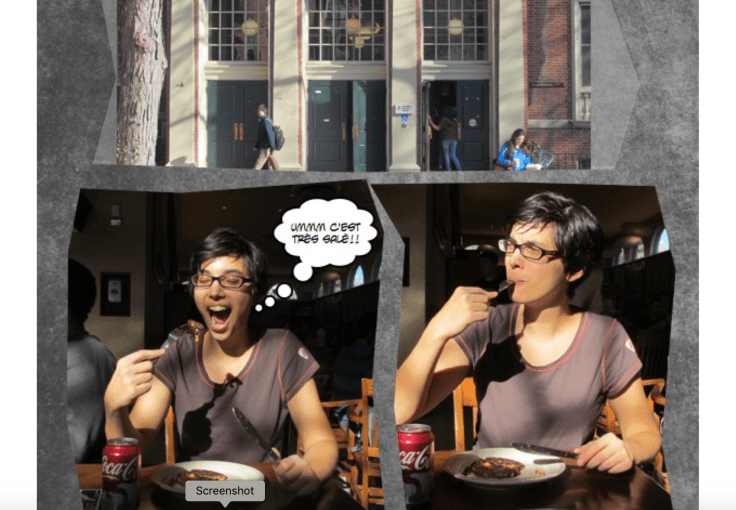
Another use of visual that insists heavily on format appropriateness is Comic Life. In this assignment, students are asked to first write a story, then shoot it, and then edit it into the software Comic Lie, using the 30 days free trial. This allows students to go through all the stage of thinking a scenario and creatively shooting it, while being mindful of context, and using French outside of the classroom, with a signed statement saying they will use French in their group. Comic Life can be replaced with a video assignment, shot in the one shot method. I notably used the method below to have students shoot a commercial for Montclair State University, in French, in an intermediate class.
Google Maps in a content class:
The purpose of this map is to have students visualize the trajectory of the ballon in Verne’s Five Weeks in a Balloon, so the class can follow along, and decide whether the geographical descriptions are accurate in the book, but also to materialize the fact that Verne “shorten” or “elongates” time when he wishes to, at times representing the speed of a pursuit by shortening the length of a portion of the trip, and at times representing the agony of the characters lost in their balloon by stretching a portion of the trip that the balloon could have covered in mere minutes to dozens of pages.
Pins’ color of course can be changed to fit the narrative, or nature of the stop: yellow here covers chapter 22, while the ferry pins materialize where the travel starts and ends, and where the heroes get off and in the boat from and to Europe. Polygons with color fills are used to materialize possible areas where the balloon can be at various points in the chapter.
Google Maps in a language class:
If you click on the map, and on each pin, you should be able to see a picture for each station. The assignment is to write a story, as a group, for each subway station selected in Paris, using the picture as a prompt, and writing collaboratively. By clicking on each pin, the students can see the picture, and fill out a little commentary space which they then can save. Their classmates can see the updates in real time, and learn about the other stories as they are going.
Comic Life and creative visual assignments:
You can find a more detailed write up of the approach below, by clicking on the link Roman Photo Activity, but the barebones of this is a four-staged approach, over several weeks.
On week 1, students imagine the story, in class. They write a synopsis, then develop the characters, locations and timeline of the story.
On week 1-2, students write an online storyboard, in a Google shared document, in the form of a table with an image number, dialogue inscribed in the image, and location of the shooting. They give me access to this document, so I can edit/comment in order to minimize grammatical mistakes in the end result/give feedback.
On week 2-3, they shoot the pictures, out of class. At the end of week 2 or 3 depending on the length of the exercise, they put together the roman photo in class–they import the pictures into the pre-set frames, write the dialogue, finalize and save the pages. Either on the same week or a week following they present their work to the class, online or in real life
Occasionally, I’ve had interesting stories to go with this exercise, such as the time my students were finishing a shoot in the ballroom downstairs from our classroom, and decided to go up the stairs to the prized electronic organ of the university, which, unbeknownst to them is protected against thievery by a step-pressure alarm. As soon as they stepped higher than mid stair the alarm went off, and a Public Safety officer was dispatched. My students came to fetch me upstairs, where I was helping other students edit their roman photo, and I came down to explain to a concerned officer what was happening. After he stopped laughing, he offered to feature in the roman photo, which happened to have been a murder investigation! The students were able to shoot the discovery of the body and arrest of the suspect by DPS officers, thanks to his collaboration.
On another occasion, students asked me to be Patient Zero of a Zombie worldwide outbreak. In their story, I caught a nasty bug turning me into a zombie by eating one of the notoriously bad veggie burger of the Sharpe Refectory (fondly known to Brown undergraduates as the Ratty for its old and ratty interior). The students, the only ones left in Rhode Island immune, were then led by a mysterious librarian on a quest at the libraries and museums spaces of the university where, in the vault of one Annmarie Brown, they found a manuscript detailing a cure, hidden in a hole in the wall. Needless to say I recovered miraculously from my ailment and went back to teaching French.
Saved at last!
 The Traveling Scholar | AC Sieffert, PhD