Sick Bodies, Weak Minds, Silent Voices
Discourses of Disempowerment and the Female Body
1800s-2000s
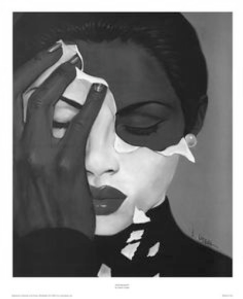
Copyright Sophie Le Page
Artist rendition of a gender inverted Frantz Fanon’s Black Skin, White Masks
Goals of the Class:
In the context of the colonial West, gender plays an important part, between normative discourses of femininity, and the layers surrounding the construction of the relationship between femininity and whiteness in French society. What are these layers? This class aims to show you how female bodies, and in particular female bodies of color, are used as a proxy for colonial discourse and patriarchal structures, and what it highlights about gender and civic spaces in the French world, from the nineteenth to the twentieth century. This class will lead you to articulate the relationship between the body of white women and their need to displace disempowerment into women of color, and how current African authors seek to reverse or understand this problematic relationship between race and normative discourses of femininity.
In this class, you will learn to analyze the text to look for instances in which the body is made the stage of representation, what constituted normative discourses of gender, and how they were built and interacted with real women. You will also discuss the place of the body in political discourse and in public spaces.
The class will proceed in four sequences. The first, Motherhood and the Normative Body, will examine discourses on gender, what it is, and how it articulates within the colonial discourse. The second, Nakedness and the Physical Body, will show the relationship between the gaze and the naked body, showing in parallel white bodies and bodies of women of color. The third, Illness and the Medical Body, will study the creation of a medical science of the female body, highlighting examples of sick bodies to explain how this medical discourse acts out disenfranchising scenarios first in white women and then in women of color. The fourth sequence, Power and the Racial Body, will highlight how the dominative relationship between black bodies and colonial discourse is evolving and being fought.
In this class, you will:
- Get a fundamental critical text basis upon which you will be able to form your own understanding of issues of gender, race, and sexuality.
- Learn how to discern layers of overlapping identities.
- Learn how to use unusual sources, such as non-textual ones like photographs and medical reports, or textual, such as travel journals.
- Develop your writing and critical skills.
- Develop your argumentative skills.
Class Material (at the Bookstore):
Diome, Fatou. The Belly of the Atlantic.
Class Packet:
- Selected readings from Eberhardt, Isabelle. Writings on the Sand.
- Bentzon, Th. The American Woman at Home, selected readings.
- Showalter, Elaine. “The History of Hysteria: The Great Doctors” in Hystories. New York: Columbia University Press, 1997.
- Selected readings from Baudelaire, Charles. Flowers of Evil.
- Selected readings from Dieulafoy, Jane. Susa.
- Selected readings from Duras, Claire de. Ourika.
- Selected readings from Djebar, Assia. Women of Algiers in Their Apartments and Fantasia, An Algerian Cavalcade.
Online Material:
- Paris, Capital of the Nineteenth Century: an online repository of images linked to Paris, we will interest ourselves with the medical images section.
- The Life and Times of Sara Baartman. Icarus Film, 1998.
- Films from Josephine Baker, Siren of the Tropics, Princess Tam Tam.
 The Traveling Scholar | AC Sieffert, PhD